
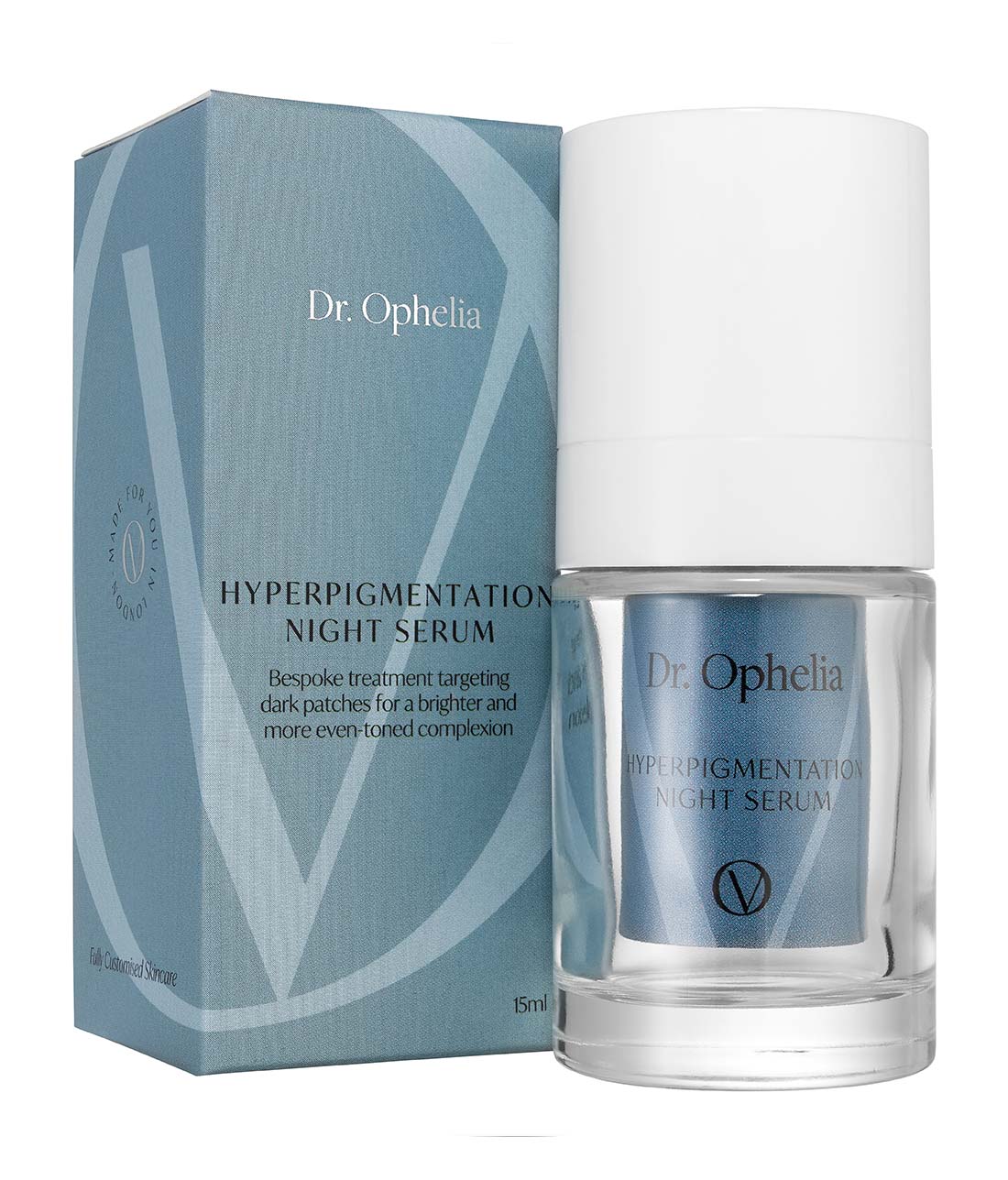
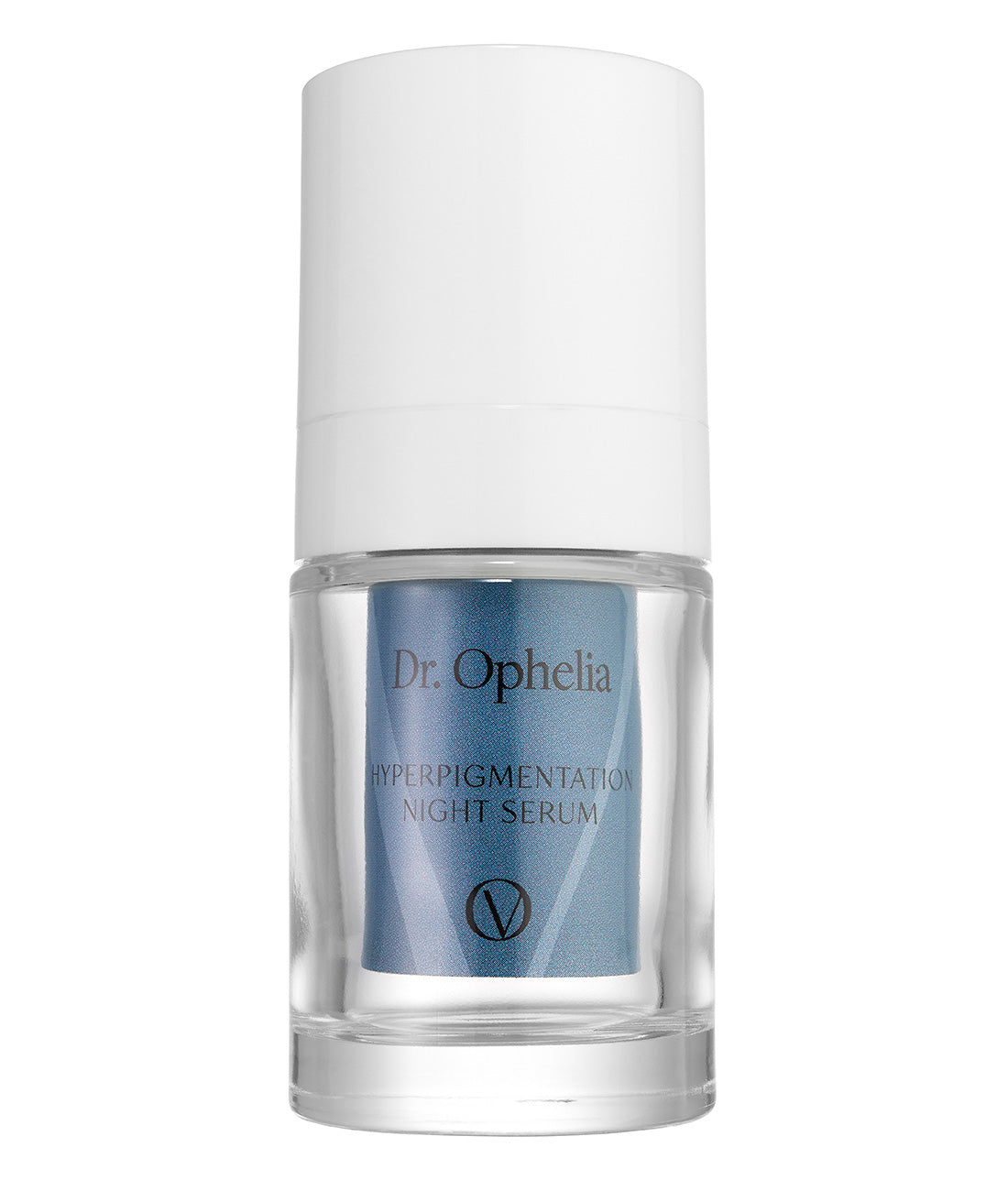
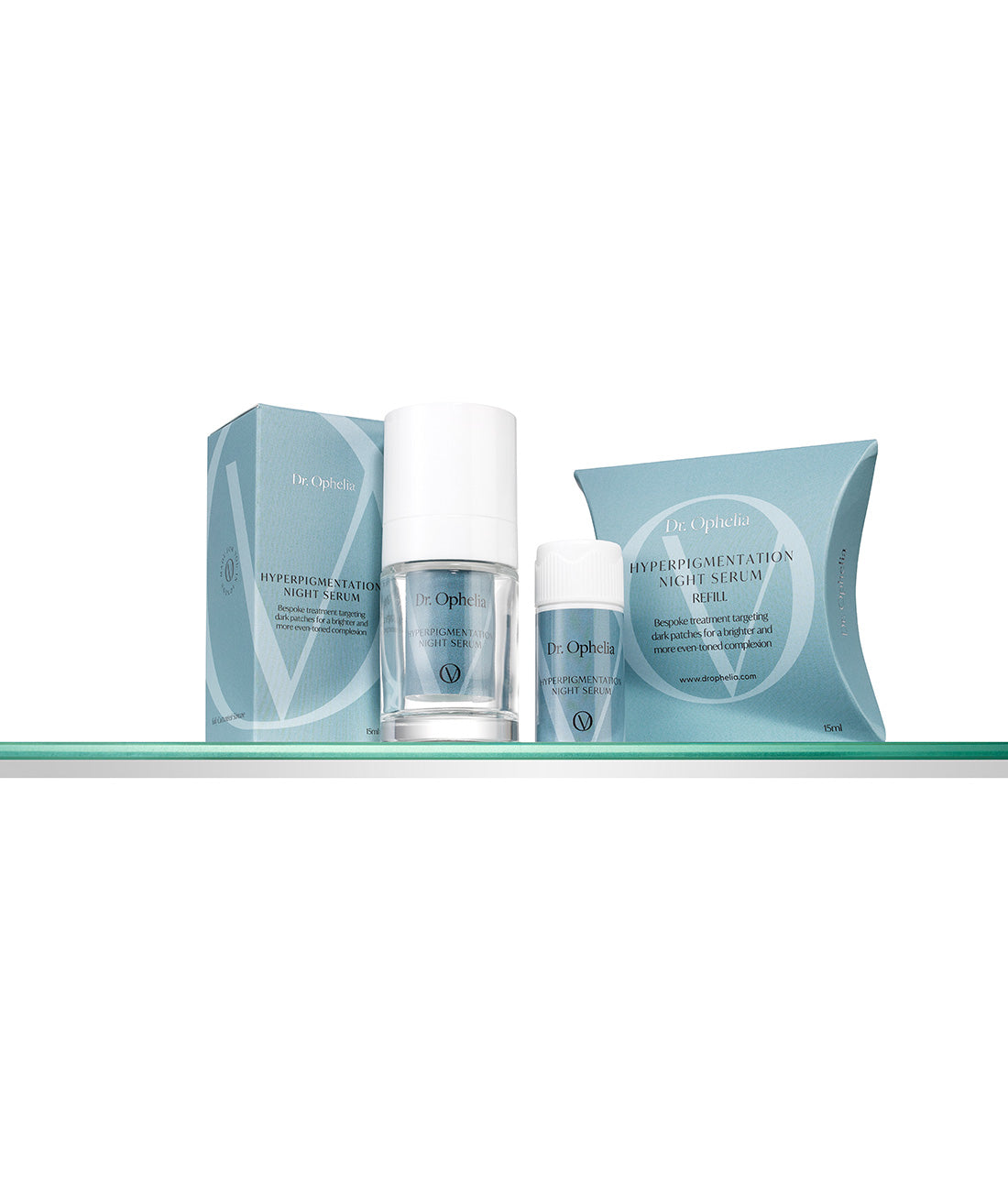
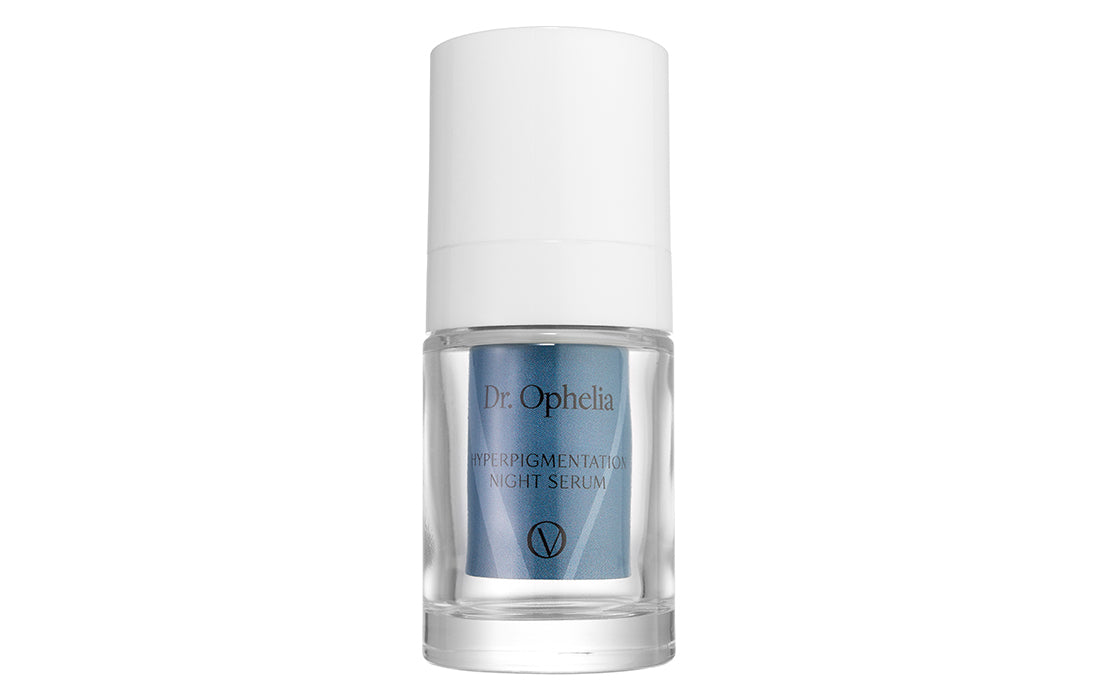
HYPERPIGMENTATION NIGHT SERUM
The prescription half of the regime, for melasma and stubborn pigmentation, used in supervised courses rather than continuously.
Recyclable Packaging
Suitable for Vegans and Filler Free
Choose options
What This Is
The prescription half of the regime, for melasma and stubborn pigmentation. What matters most on this page is not what it contains but how it is meant to be used.
This formula's active is the dermatology reference standard for pigmentation, and we measure every other ingredient in the category against it. It is a prescription-only medicine in the UK and is banned outright in cosmetic products, for reasons this page sets out honestly.
Used properly and under supervision, it does what nothing over the counter can. Used continuously for years without anyone watching, it can cause a form of pigmentation considerably harder to treat than what you started with, and that risk falls disproportionately on brown and Black skin. Both things are true at once. That is why this page requires an assessment rather than a checkout, and why Dr Ophelia prescribes it in courses rather than as a routine to stay on.
How This Is Meant To Be Used, Which Is Not Continuously
Dr Ophelia uses these serums for one or two courses a year. Between courses, she uses a simple cleanser and sunscreen and nothing else. That is the protocol for her patients too.
The risk is real and documented: prolonged, unsupervised use can cause exogenous ochronosis, a blue-black discolouration that paradoxically results from the treatment itself. In the published case series that characterised it, 64% of patients had skin type V or VI, and another 28% were type IV. It is overwhelmingly a condition of people with skin colour. Average duration of use before it appeared was over nine years.
A third of cases were misdiagnosed; in that series, 32% were initially given a different diagnosis, often melasma, so people whose pigmentation was caused by their treatment were told to use more of it. That is the failure supervision exists to prevent.
The evidence points to continuous use, not the drug; a 2024 review in the American Journal of Clinical Dermatology puts the elevated risk at over six months of continual use in skin of colour, or use without medical supervision, and notes the ingredient is conventionally rotated on and off for this reason. Risk also rises at higher concentrations, particularly in alcohol based vehicles.
So the protocol is a course, then a break, then reassessment. If you have been buying something like this online and using it continuously for years, that is the most useful thing on this page, and Dr Ophelia would rather you took it and bought nothing from her at all.
What Goes Into It
Factual information about the active ingredient in this preparation, for patients considering treatment. Not a recommendation, and not a substitute for the assessment.
Hydroquinone
Hydroquinone reduces pigment production by inhibiting tyrosinase, the enzyme that begins the process, and reducing pigment-producing cell activity.
In the UK, it is a prescription-only medicine and is entirely prohibited in cosmetic products, so you cannot lawfully sell it without a prescription. If you bought something containing it without a prescription, it was sold illegally, and you don't know what concentration you were using. Trading Standards are actively seizing these products from high streets across the UK.
For this formula, concentration is a safety decision. Risk rises with concentration, particularly in alcohol based vehicles, which is one reason yours is compounded rather than bought. Concentration, base and course length are set from your assessment.
Most prescription skincare sorts you into one of a few batch-manufactured strengths. Here, nothing exists until it is prescribed, and you can set and change the active, concentration, and base independently. If your skin doesn't tolerate the base, it changes; anything you have reacted to is left out, and the next bottle can differ from this one. When dose and duration are the whole safety argument, that is the point.
Side effects. Irritation, redness, dryness, and stinging are most common and are usually managed by adjusting concentration or base. Contact dermatitis occurs in a minority. Exogenous ochronosis, described above, is the serious one.
Do not use it during pregnancy or while breastfeeding, and, as it stands, nothing else in this range can be used either. The Day Serum contains kojic acid, on which pregnancy safety data is insufficient. Pregnancy melasma is common and worth taking seriously, so we'll schedule a New Patient Skin appointment rather than refuse.
What it deliberately excludes: no fragrance, and none of the ingredients dermatologists most commonly see cause contact allergy. If you have been patch tested, send the list, and we'll check the formulation against it.
The preservative system is lighter. A shop product must survive years of manufacture, storage and shelf life, which takes a heavy preservative and stabiliser system, a common cause of irritation. This serum is made when prescribed and used within months. It is not preservative-free, but it tends to suit reactive skin better, which matters because irritation in pigmented skin causes more pigmentation.
What You Actually Have
Melasma is symmetrical, blotchy and hormonally driven, flaring with pregnancy, the combined pill and heat. It responds well but recurs, hence the courses. Post-inflammatory hyperpigmentation is the mark left after a spot, ingrown hair, eczema, or an overly aggressive procedure, and it's more common and persistent in brown and Black skin. Sun-induced pigmentation is cumulative and usually better defined at the edges.
A vascular component is routinely missed. Dilated vessels and flat red or pink marks often sit under or alongside the brown. Pigment treatment does nothing for the vascular component, so people often mistake a partial result for failure. A vascular laser can treat it effectively, whereas a serum can't.
Epidermal pigmentation sits near the surface and responds well. Dermal pigmentation sits deeper and responds considerably less. Most people have a mixture, which we determine by examination, not a photograph.
Skin consultation, 130 Harley Street. £375 - An examination to determine whether pigmentation is epidermal, dermal, or mixed; whether it has a vascular component; and whether it is melasma.
The consultation is recommended if you have used a depigmenting product bought without a prescription, used something similar continuously for more than six months, found pigmentation worsening on treatment, have skin type IV, V or VI with a long treatment history, are on hormonal treatment or regular medication, or have never had your pigmentation diagnosed.
The consultation also looks for drivers. Bloods are part of the assessment, as nutritional deficiencies affect skin tone. Progesterone and testosterone can worsen pigmentation, and several medications cause it directly and are frequently managed as melasma, which does not work.
An assessment does not always end in a prescription. Sometimes a topical isn't the right tool; you need to stop what you are using, or what you have isn't what you think. Dr Ophelia is the sole prescriber for every formula in this range.
How to Use
Use one pump (about 0.5ml) on clean, dry skin at night, applied to pigmented areas rather than the whole face unless advised.
Sunscreen every morning, tinted if possible. Visible light as well as UV drives pigmentation, particularly in darker skin, and tinted sunscreens containing iron oxides protect against it where clear ones largely do not.
Use it for the prescribed course, then stop. Course length is set at assessment. Between courses, use the Day Serum or cleanser and sunscreen.
Tell Dr Ophelia if it stings, flakes, or reddens beyond the first week or two, as inflammation in pigmented skin can cause more pigmentation. Stop and contact us immediately if pigmentation darkens, greys, or takes a blue-black cast.
Allow twelve weeks before judging, and photograph monthly in the same light.
When a Topical Is Not Enough, There Is Somewhere To Go
The next step is an appointment at 130 Harley Street, not a referral elsewhere.
Options include PicoSure Pro, a picosecond laser suited to darker skin types where older devices risk making things worse; Fraxel and Clear and Brilliant for deeper pigment and texture; vascular laser; IPL used carefully; AviClear where active acne generates the marks; and HydraFacial Platinum as a supporting treatment. Device selection and settings for skin of colour are the whole game, and in-clinic treatment is priced and booked separately.
Frequently Asked Questions
Assessed is the right word. Prolonged unsupervised use is the specific risk factor for exogenous ochronosis, especially in skin of colour. Book a consultation with Dr Ophelia or anyone else, and take the product with you.
Used in supervised courses at an appropriate concentration, yes. Used continuously for years at an unknown concentration, the risk falls almost entirely on darker skin.
No, nor can the other two serums in this range, as they stand. Nothing here is supplied off the shelf in pregnancy or while breastfeeding. Book a New Patient Skin appointment to discuss what is reasonable.
Mostly local irritation, redness, dryness and stinging; the serious one is exogenous ochronosis. Tell me rather than pushing through.
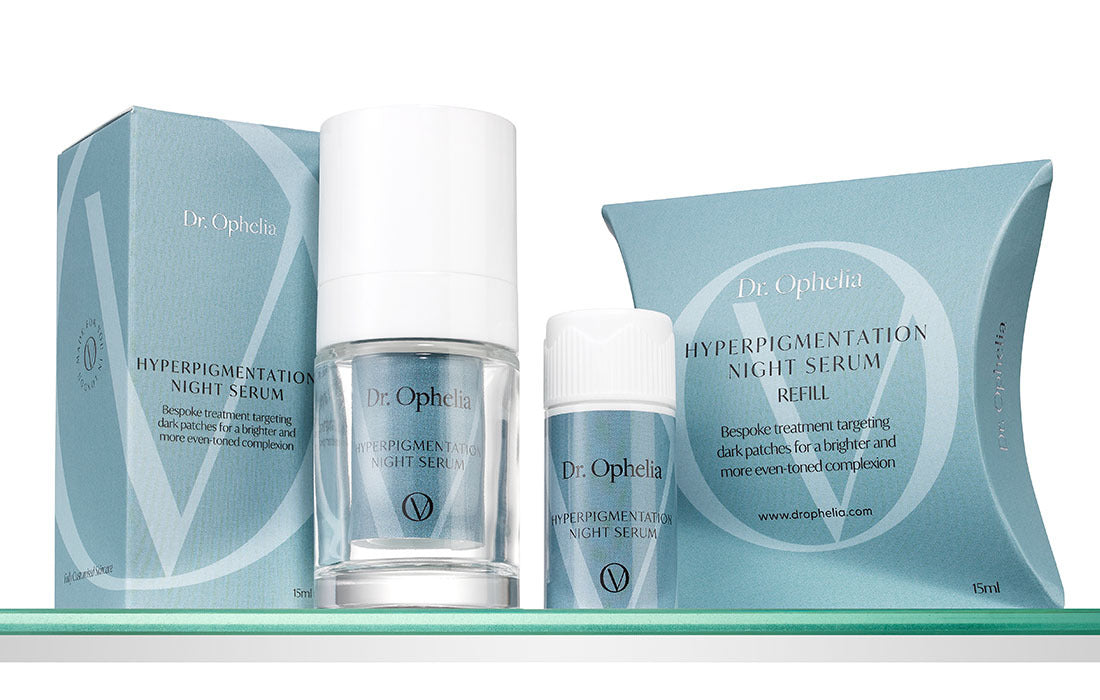
£125 for a 15ml refill pump, roughly two months at one pump daily, once prescribed. The questionnaire is free, and a skin consultation is £375. Allow twelve weeks before judging, often four to six months for the full picture.
The active is licensed, but this preparation is compounded to your formulation, making it an unlicensed special, a lawful route for a prescriber to obtain a preparation not commercially available. Responsibility for prescribing sits with Dr Ophelia.
A GPhC-registered UK pharmacy compounds it, with a named superintendent pharmacist. Clinic registered with the CQC, provider ID 1-27377085712, location ID 1-29095875525. GMC 6149018.
AWARD WINNING PRIVATE CONSULTANT DERMATOLOGIST
Dr. Ophelia Veraitch is a globally recognised dermatologist with an unparalleled educational foundation and international expertise in both medical and aesthetic dermatology.
As a private consultant on Harley Street, she specialises in diagnosing and treating complex skin and hair conditions while also offering a full range of professional aesthetic treatments.
Alongside her clinical work, Dr. Ophelia has developed her namesake line of prescription-strength skin and hair products, bringing her world-class knowledge and experience directly into patients’ hands, to continue treating their skin at home.

Patients Most Often Pair This With
Hyperpigmentation Eye Night Serum:
For pigmentation around the eyes, where the causes are more varied than most people assume.
Know MoreA skin consultation with Dr Ophelia, £375.
Particularly if anything in the list above applies to you.
Book Consultaion