
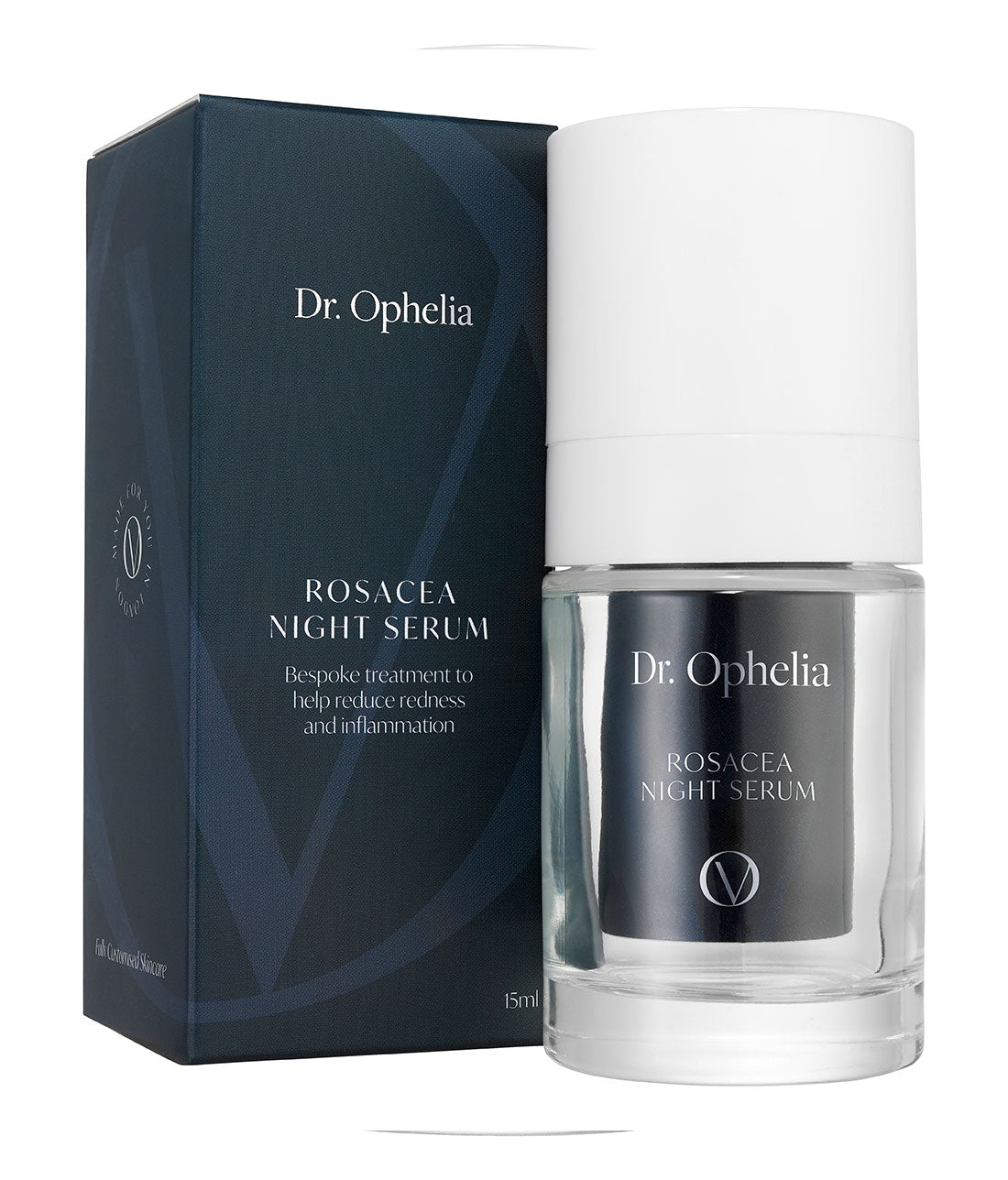
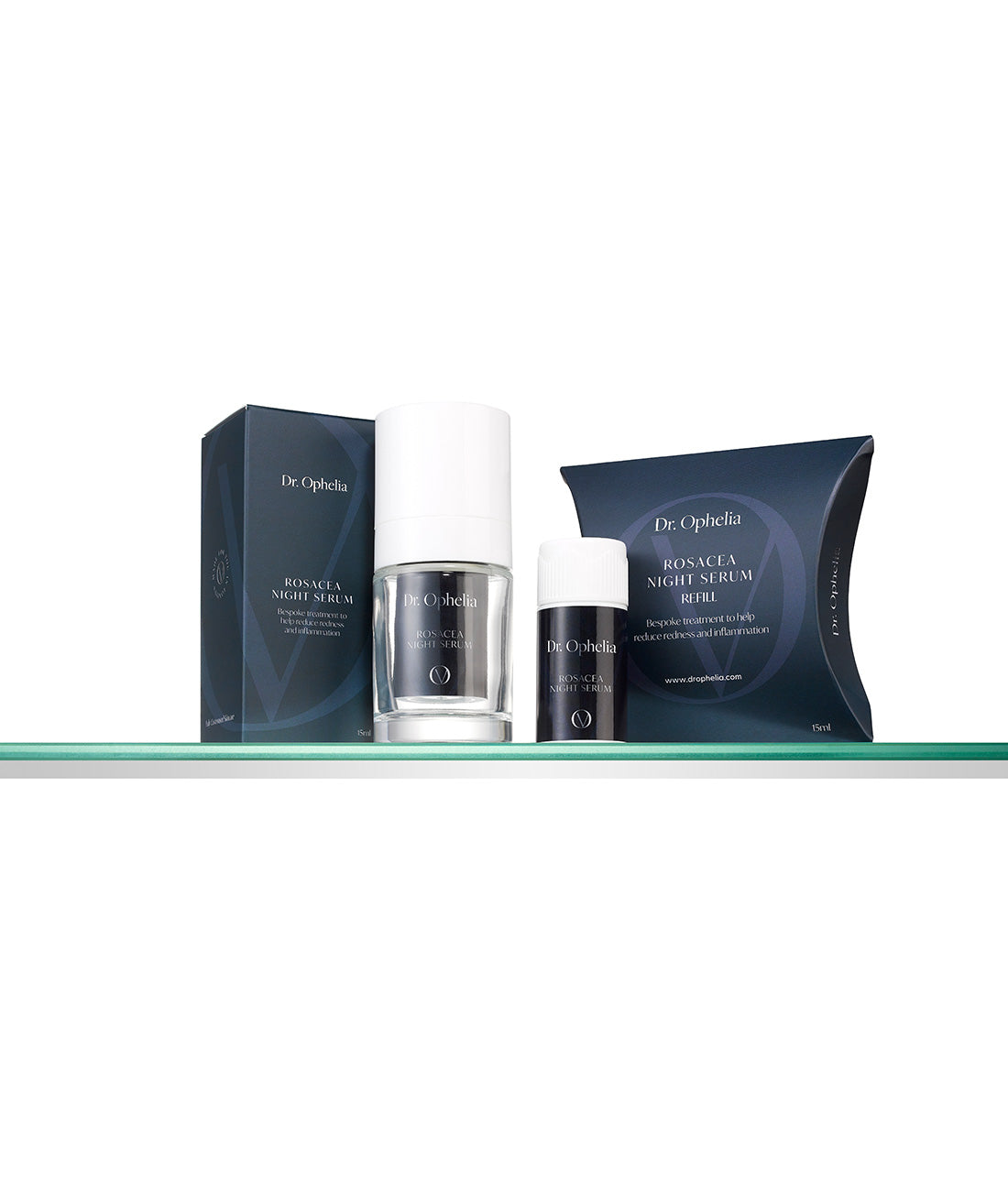
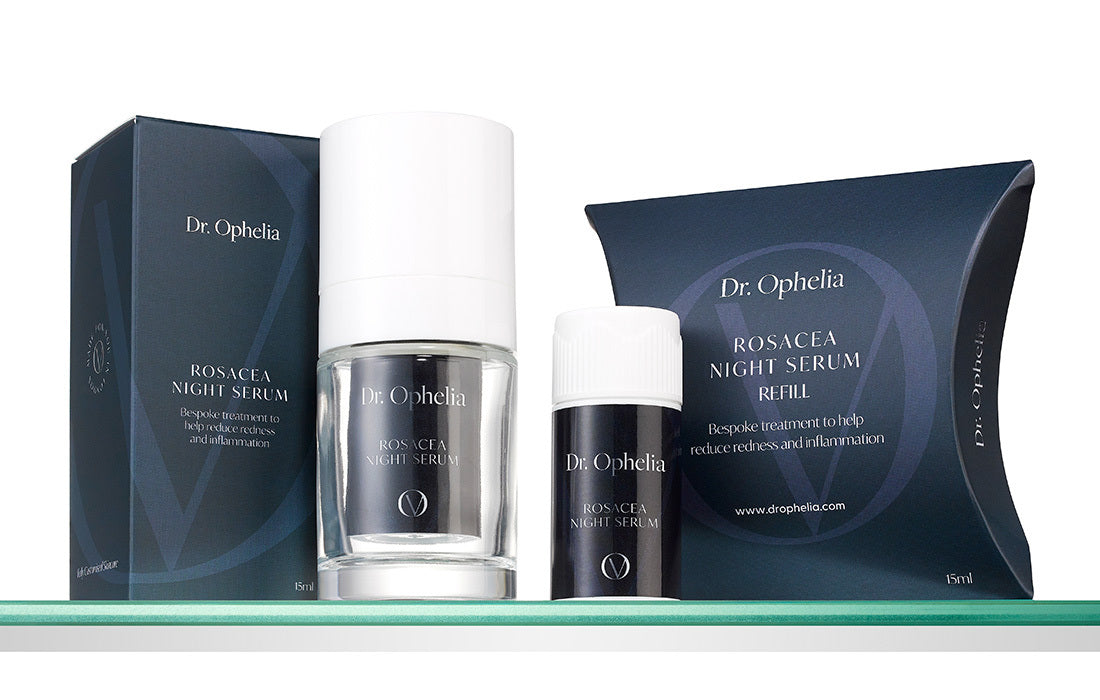
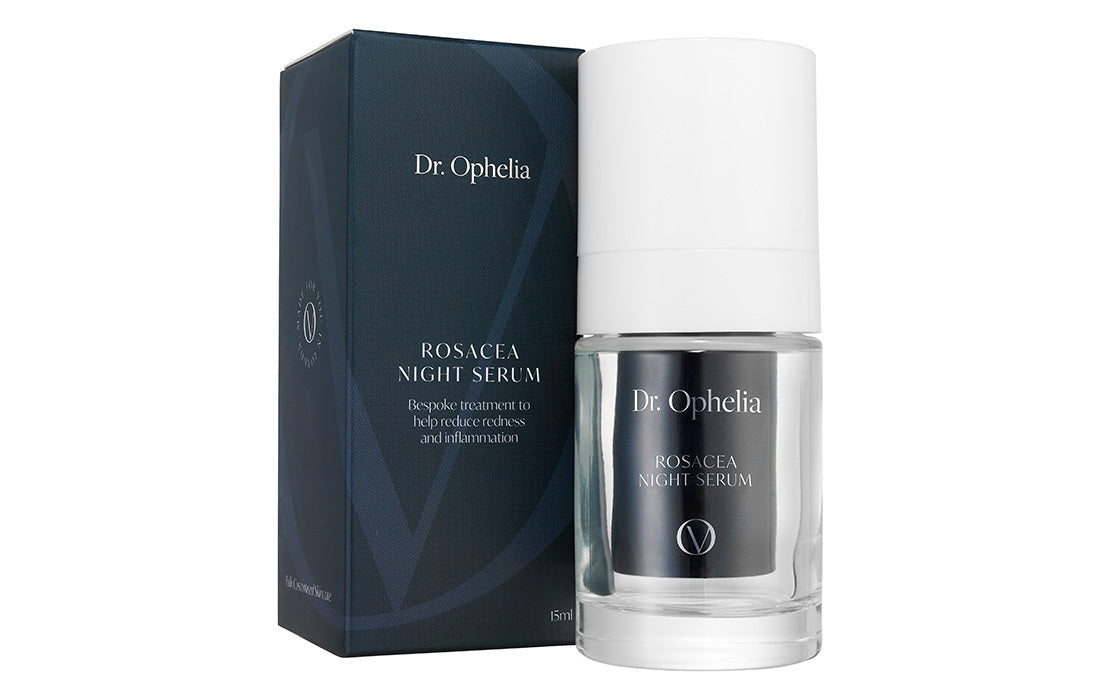
ROSACEA NIGHT SERUM
Bespoke treatment to help reduce redness and inflammation with new and improved formulations.
A bespoke night serum which includes the two essential active ingredients dermatologists commonly prescribe to treat rosacea but blended into one treatment.
New environmentally friendly 15ml refill pumps. 1 pump a day advised to the face gives a dose of 0.5mls per day to the face. Subscription advised and monthly refills will be sent out for repeat orders.
Recyclable Packaging
Suitable for Vegans and Filler Free
Choose options
What This Is
This is the evening half of a two-part system. It exists because rosacea patients were leaving Dr Ophelia's clinic with four or five products and a running order. The clinical logic was sound, and almost nobody could follow it. Something would sting, the order would get muddled, or one product would react with another, and patients abandoned the routine around week three.
The system centres on one application in the morning and one at night, each containing the actives that belong at that time of day, so the skin is treated around the clock. Night is when the more active work happens, as skin repairs overnight and there is no sun exposure to consider.
Why Fresh Matters, and Why It Matters Most in Rosacea
Rosacea skin is reactive. The barrier is impaired, things sting when they shouldn't, and the rate of genuine contact allergy is materially higher than in the general population. That is a documented feature of the condition.
A systematic review published in 2025, covering sixteen studies and 2,045 patients, found people with rosacea around twice as likely to be contact sensitised. Tested specifically against cosmetic ingredients, they were more than four times as likely. Setting aside nickel and cobalt, which come from jewellery, the most commonly positive ingredients are methylisothiazolinone, fragrance mix, Balsam of Peru, and Kathon CG. Two are preservatives, and two are fragrances.
That is the argument for how this is made. A shop serum must hold unstable actives through manufacture, shipping, a warehouse, a shelf, and a bathroom cupboard, and the preservative systems that make that possible are the ones showing up positive on rosacea patch tests. You wouldn't drink two-year-old milk, so why put a two-year-old serum on skin that reacts to everything?
This serum is compounded when prescribed and used within months. It needs a far lighter preservative system and contains no fragrance. It is not preservative-free, and any leave-on product claiming to be is worth treating with caution, but it carries what it needs rather than what a shelf life demands.
If you have been patch tested, send the list. We check the formulation against it so your bottle contains none of your confirmed allergens.
What Goes Into It
Factual information about the ingredients in this preparation, for patients considering treatment. Not a recommendation, and not a substitute for the assessment.
Metronidazole
An antibiotic, but not used here for its antibiotic action. In rosacea, it has direct anti-inflammatory and antioxidant effects and has been a standard topical treatment for inflammatory features for decades, with a long record of tolerability. That matters in this condition because the most common reason a rosacea treatment fails is not lack of potency, but that the patient cannot tolerate it.
What it does and does not treat. It works on papules, pustules and inflammatory redness. It does much less for fixed background redness and visible broken vessels, which are vascular rather than inflammatory. That distinction is the most important thing to understand about rosacea treatment and is set out in full on the Rosacea Day Serum page.
Side effects—local irritation, burning, stinging, dryness, and itching —are usually mild. Contact dermatitis occurs in a minority.
Azelaic Acid
Occurs naturally in grains including wheat, barley and rye. It is anti-inflammatory, so it works on papules and pustules alongside the other active. It is antimicrobial. And it reduces pigment production, which matters because rosacea leaves marks. Inflammatory lesions on brown and Black skin often resolve into post-inflammatory pigmentation, which patients often mind most once the bumps settle. Treating inflammation without addressing what it leaves behind is only half the job.
Side effects. Stinging, burning and itching on application are common early and usually settle within a few weeks. It can be more noticeable than the other active, so we adjust the concentration.
What is deliberately not in it. No fragrance, and none of the ingredients most commonly implicated in contact allergy in this patient group.
Made To Order, Not Made In Batches
Most prescription skincare runs on a handful of set variables: a couple of actives at a couple of strengths, manufactured in large batches, with a questionnaire routing you to the nearest option. That keeps costs down, makes it a reasonable business, and also sets its limit. Here, nothing exists until you prescribe it. You can set and change the actives, concentrations, and base independently.
In rosacea, that is not a refinement. The most common reason treatment fails is that it stung and the patient stopped, and what usually needs changing is the base rather than the drug. If one active is too much, you can build the formula with the other alone, which is considerably better than abandoning both. Rosacea skin also changes with the seasons, so the formula needed in February is often not the one needed in July.
Who This Is For
People with the inflammatory features of rosacea, used alone or alongside the Day Serum. People whose rosacea has left marks, particularly in brown and Black skin. People who react to skincare, which is the rule, not the exception, in this condition. People with patch test results and a list of confirmed allergens.
Not suitable if you are pregnant, trying to conceive or breastfeeding - Nothing in this range is supplied off the shelf in pregnancy. Rosacea commonly flares in pregnancy, and what is reasonable depends on the individual, so we discuss this in person rather than via form.
Not suitable if your rosacea has not been diagnosed -Seborrhoeic dermatitis, perioral dermatitis, lupus and steroid-induced facial redness all resemble rosacea, and the last can worsen on some rosacea treatments.
If you mainly have fixed redness and visible vessels, a topical helps but is not the main answer. See the Day Serum page and book an assessment before buying a serum.
What this can and cannot do - Rosacea is managed rather than cured. With proper treatment, most people reach a point where flares are infrequent and mild, and the skin is comfortable. Treatment also works better alongside trigger management. Heat, sun, alcohol, spicy food, stress, and sudden temperature changes are the usual culprits, and identifying yours makes more difference than most patients expect.
Skin consultation, 130 Harley Street. £375 - For redness and visible vessels as the main complaint, an uncertain diagnosis, or when laser or oral treatment may be a better option.
Dr Ophelia is the sole prescriber for every formula in this range.
How to Use
One pump (about 0.5ml) at night to clean, dry skin, spread thinly across affected areas. Start every other night for the first two weeks if skin is reactive, and build up as tolerated.
Use a bland cleanser and lukewarm water—no scrubs, flannels or exfoliants.
Expect some stinging early on, particularly in the first fortnight. If it does not settle, tell Dr Ophelia rather than stopping, because she can change the base or concentration. A flare in the first week or two happens to some people and is not a reason to abandon treatment without speaking to her first.
Allow twelve weeks before judging, though inflammatory lesions usually start improving sooner. Keep going when it works. The most common reason rosacea returns is that treatment stops once the skin looks better, and you decide to step down at the review.
When a Topical Is Not the Whole Answer
This range came out of a Harley Street practice that is still running, and in rosacea that matters because the feature patients mind most is what topicals do least for. Vascular laser treats fixed background redness and broken vessels. IPL treats diffuse redness and pigmentation at the same time. Oral treatment helps when the inflammatory load exceeds what a topical can handle. Resurfacing lasers treat textural and phymatous change, most often around the nose. Device selection matters: an aggressive setting on reactive or darker skin creates a second problem on top of the first. A skin consultation is £375.
Frequently Asked Questions
It contains prescription-only medicines, so a prescriber must assess you, and several conditions resemble rosacea, one worsening on some treatments.
Possibly at first, but it is built to reduce the odds: no fragrance, a far lighter preservative system, and an adjustable base.
Enormously. Send the list, and I'll check your formulation against it.
One has a long record of tolerability on reactive skin; the other also reduces pigment production. If one does not suit you, the formula can be built with the other alone.
That is one reason the second active is in the night formula.
It helps inflammatory redness, but does much less for fixed redness and visible vessels, which need a laser. If that is your main complaint, book an assessment rather than a serum.
That is the intended system and why both exist.
No. It is managed, and when it is managed well, it stops being something you think about.
Not off the shelf. It is an in-person conversation. Book a New Patient Skin appointment.
We can adjust the actives, concentrations, and base; we make nothing until it is prescribed, and we have a vascular laser in the same building.
The actives are licensed, but this preparation is compounded to your formulation, making it an unlicensed special, a lawful route for a prescriber. I take responsibility for prescribing it.
A GPhC-registered UK compounding pharmacy, working to my prescription, with a named superintendent pharmacist on the General Pharmaceutical Council register. The clinic is CQC-registered (provider ID 1-27377085712, location ID 1-29095875525), and my GMC number is 6149018.
£125 for a 15ml refill pump, roughly two months at one pump daily. The questionnaire is free; the skin consultation is £375 and is charged separately.
Six months from the date it is made, which is on the bottle.
No. You can't return dispensed prescription medicines, and a compounded serum is a listed exception to the fourteen-day cancellation right. If it isn't working, tell me, because we can adjust the formula.
AWARD WINNING PRIVATE CONSULTANT DERMATOLOGIST
Dr. Ophelia Veraitch is a globally recognised dermatologist with an unparalleled educational foundation and international expertise in both medical and aesthetic dermatology.
As a private consultant on Harley Street, she specialises in diagnosing and treating complex skin and hair conditions while also offering a full range of professional aesthetic treatments.
Alongside her clinical work, Dr. Ophelia has developed her namesake line of prescription-strength skin and hair products, bringing her world-class knowledge and experience directly into patients’ hands, to continue treating their skin at home.

Patients Most Often Pair This With
A skin consultation with Dr Ophelia, £375
Especially if redness and visible vessels are your main complaint.
Book Consultation