
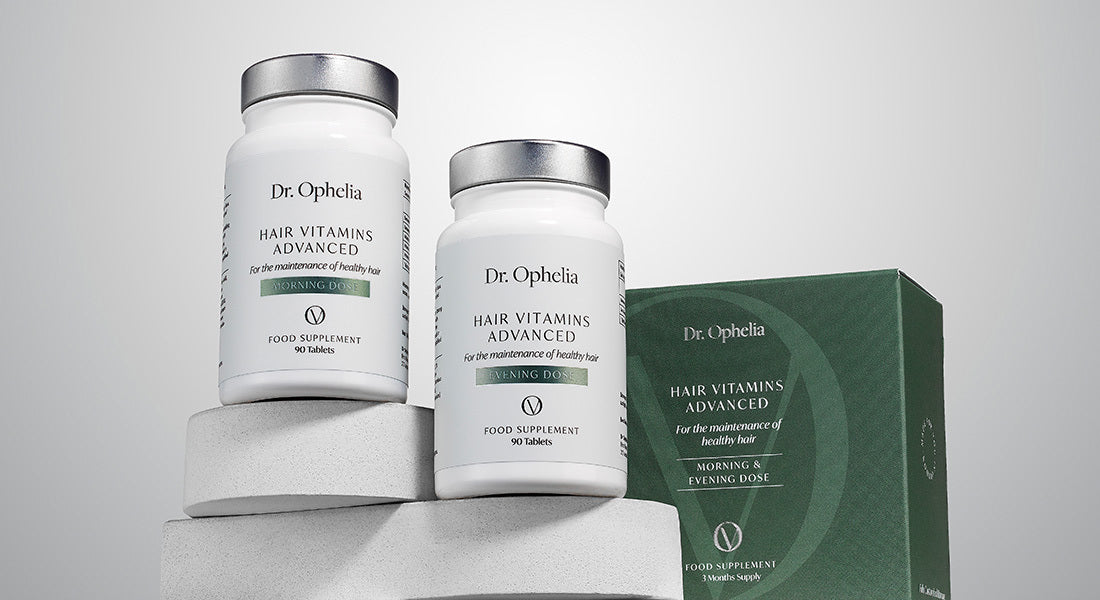
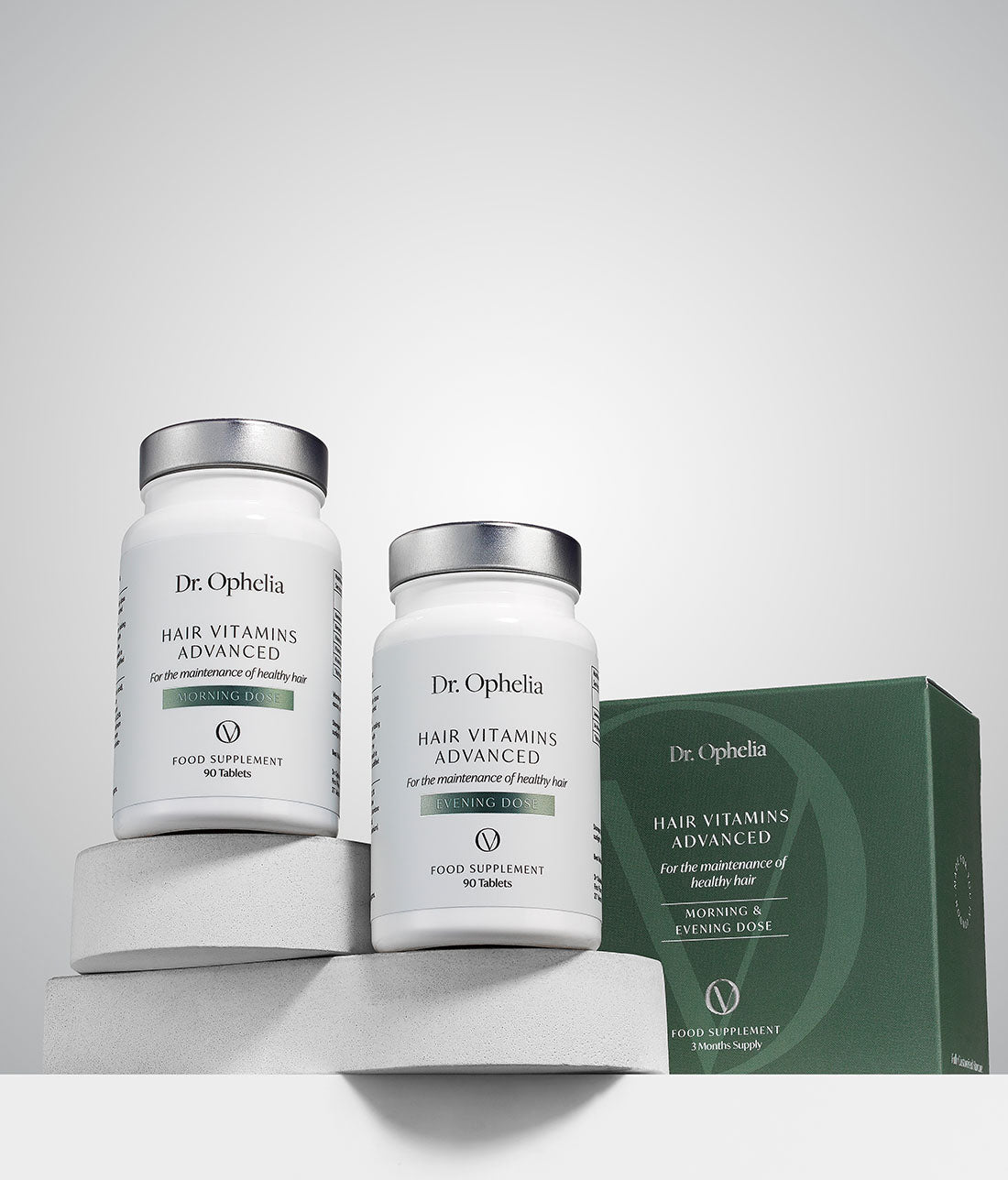
HAIR VITAMINS ADVANCED
This started as a piece of paper.
In my tertiary hair clinic, seeing cases that had already outgrown all others, I kept coming back to the same nutritional foundation. So I hand-wrote for patients: seven things, the dosage I wanted for each, and which to take in the morning and which to take at night. Then I sent them off to buy seven separately.
It worked when people managed it. Most people didn’t – seven purchases, seven labels to check the correct dosage, and an easy time rule to forget by the third week. The products they came back with were rarely the strengths I asked for, because the dosages that hair really needs are not the dosages that the high street sells.
It worked when people managed it. Most people didn’t – seven purchases, seven labels to check the correct dosage, and an easy time rule to forget by the third week. The products they came back with were rarely the strengths I asked for, because the dosages that hair really needs are not the dosages that the high street sells.
Recyclable Packaging
Suitable for Vegans and Filler Free
Choose options
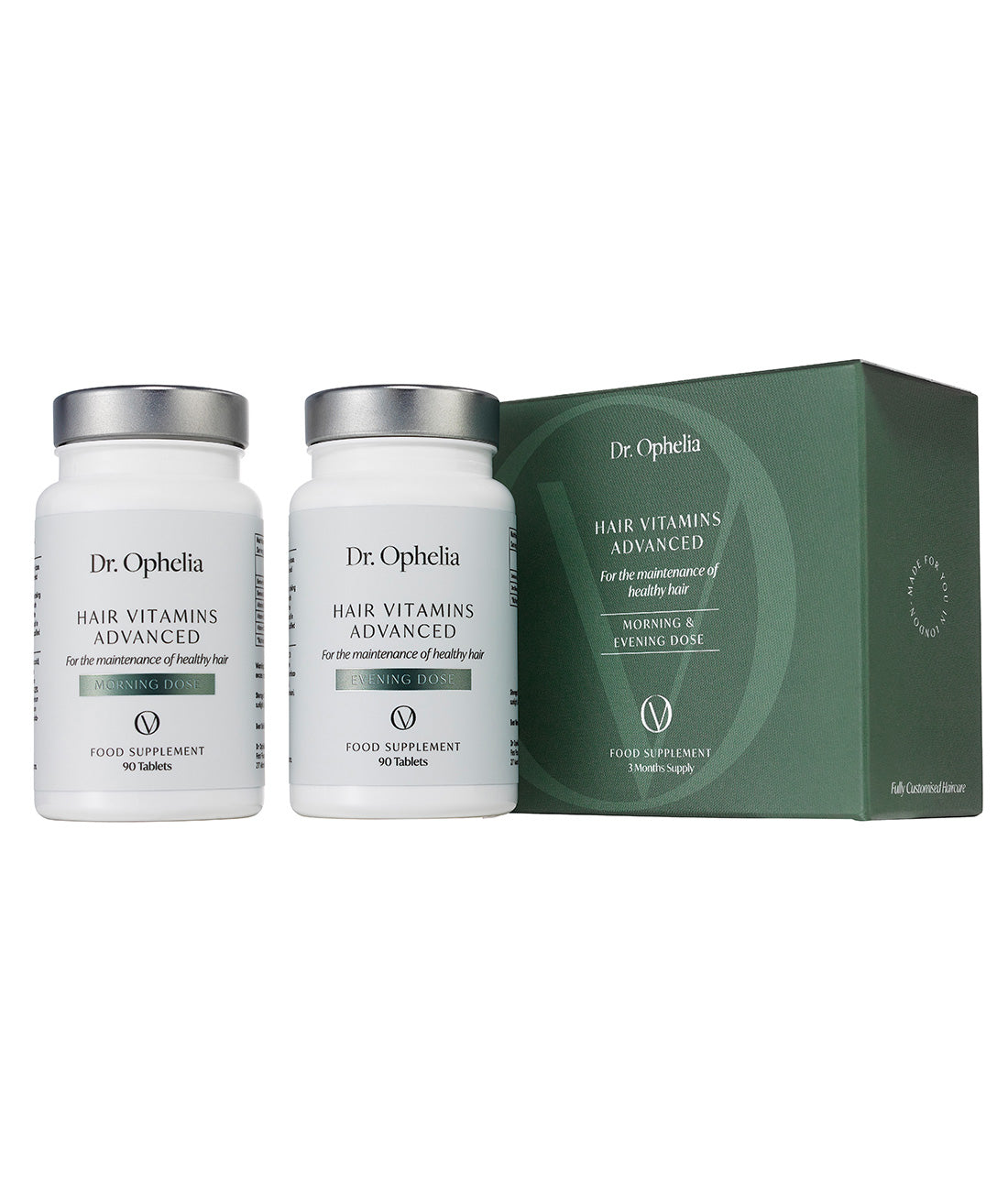
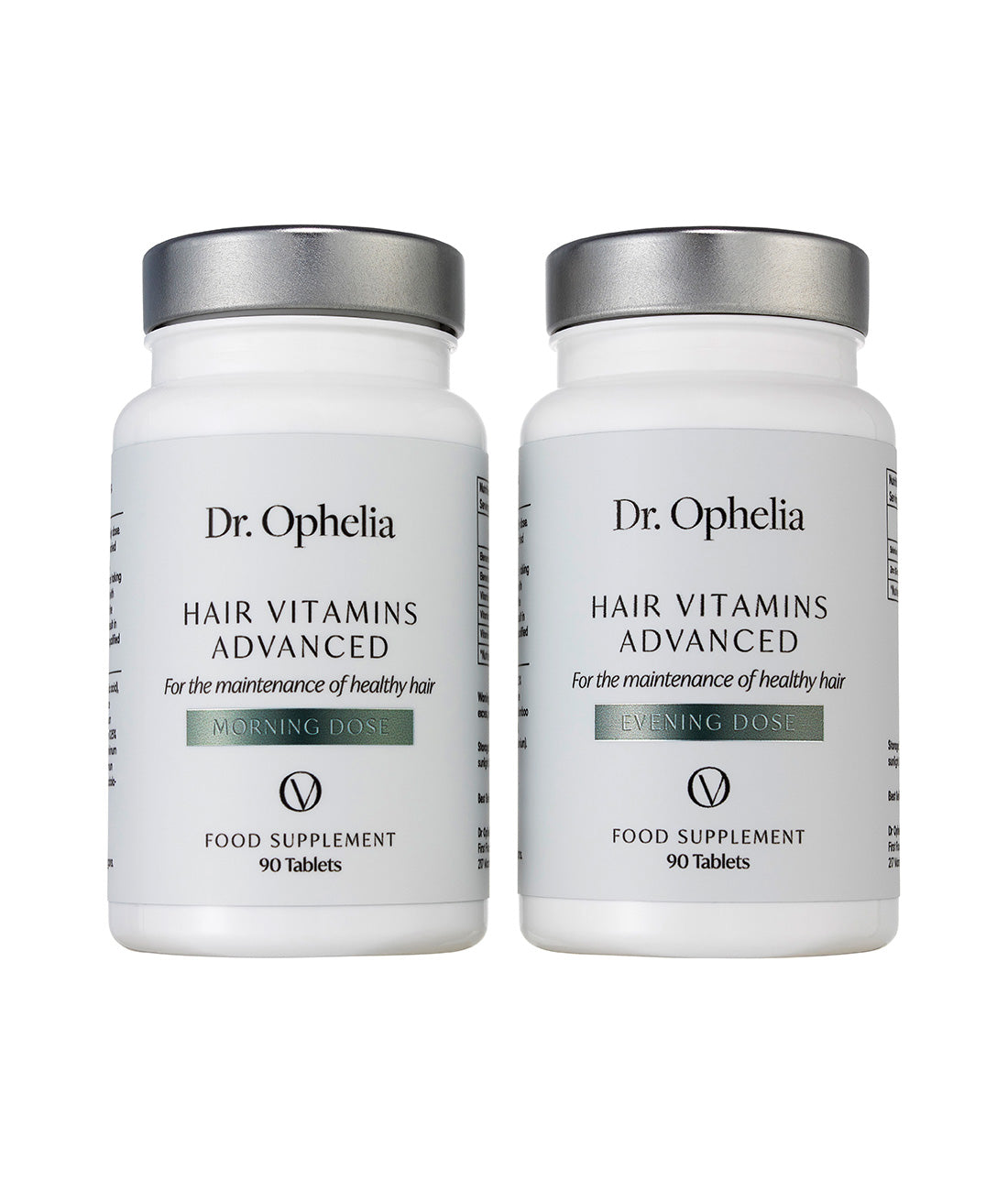
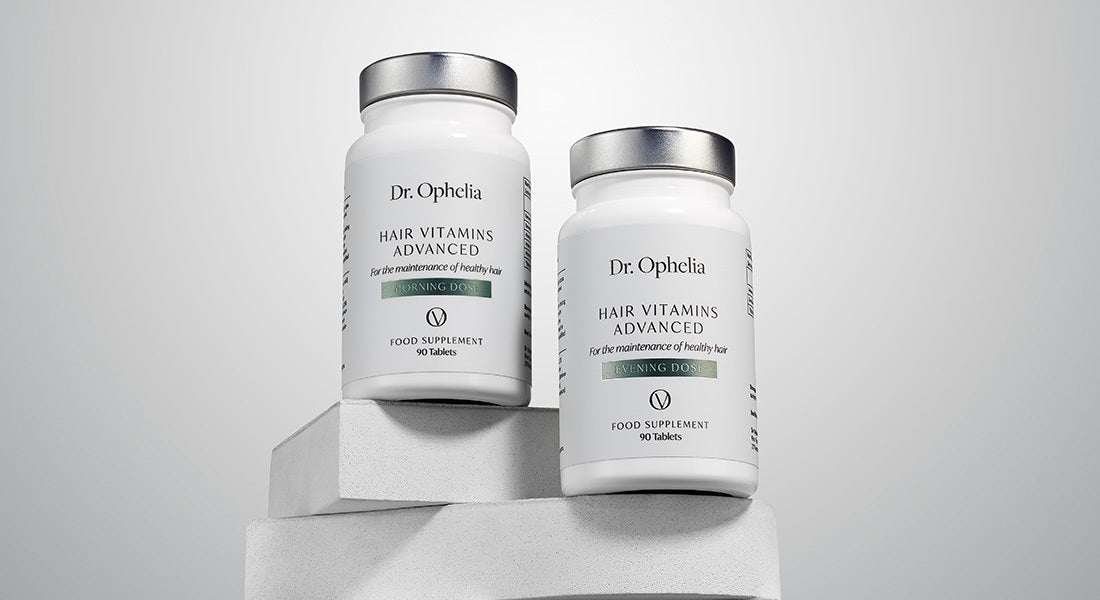
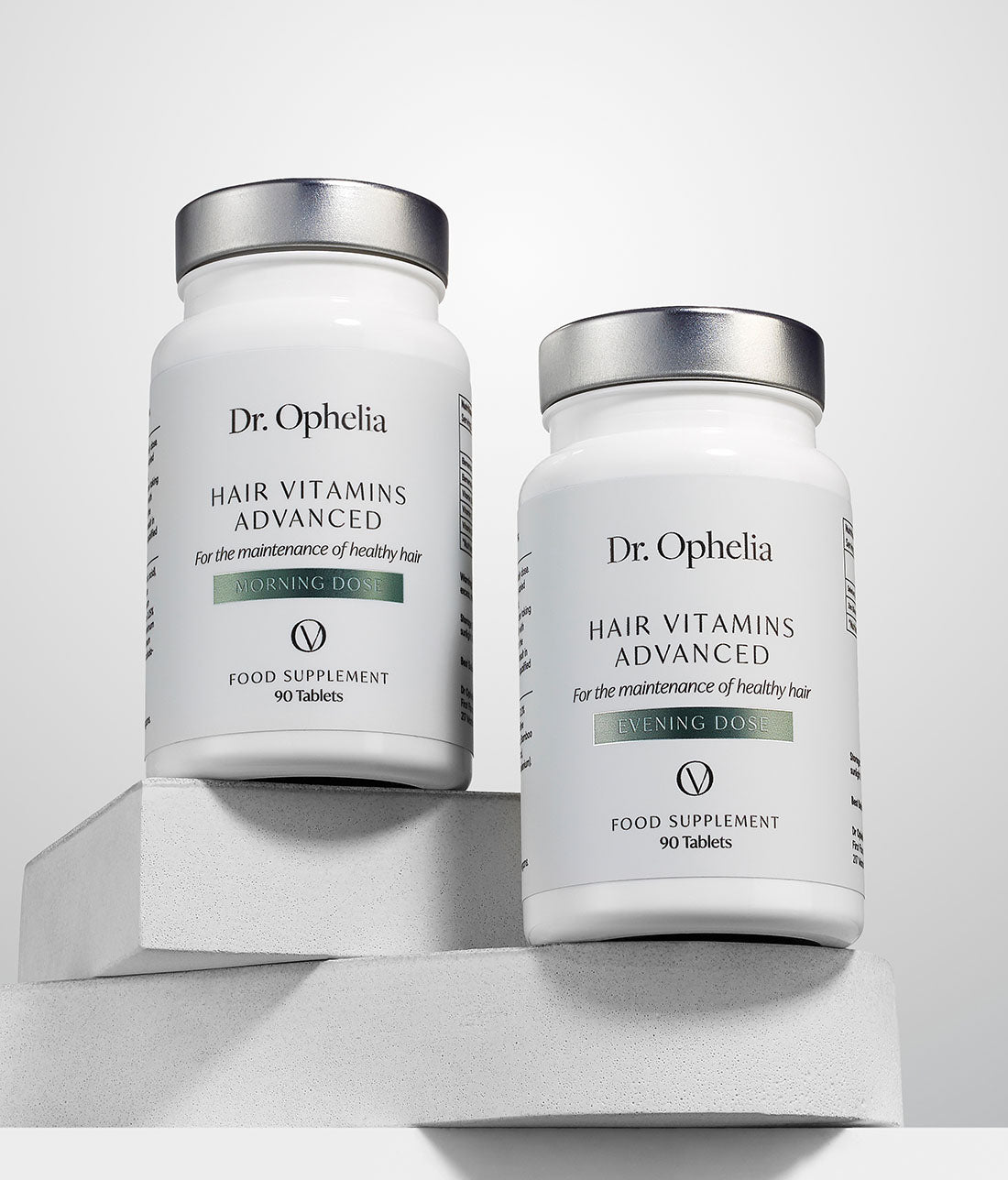
Hair Vitamins Advanced is a handwritten list, neatly formatted, in two tablets instead of seven bottles. My patients have been taking this blend for five years. The seven nutrients are a complete formula, and the brevity of the list is the point – each is there because the evidence supports it and because I was already telling patients to buy it. Nothing was added to stretch the label.
The morning and evening split is what people think of as a presentation. It’s not, and that’s why the list was hand-written, rather than bought off the shelf first. Iron and zinc compete for the same absorption pathway through the intestinal wall—when taken together, each reduces the amount of iron that can be absorbed, so they go twelve hours apart: iron in the morning, zinc at night.
Iron and vitamin C are antagonists: vitamin C converts iron into an absorbable form in the gut, so they both sit in the same tablet by design. B12 and folate pair up with them, working as a pair on the same cell division. Vitamin D goes in the morning, too.
That leaves zinc and selenium for the evening, away from morning vitamin C—which no one expects. Here the selenium is sodium selenite, and the vitamin C reduces it to a form that the body can’t absorb. Like most formulas, combine ascorbic acid and sodium selenite into one tablet, and you’ve quietly canceled out selenium while printing on the label. One design decision, three interactions made. Almost every hair supplement on the market has it all in one tablet, which is more convenient and measurably less effective.
What was left was as carefully determined as it could be. It had no biotin, because its evidence in hair had been evaluated and rejected, and because in supplemental doses it interferes with thyroid and cardiac blood tests. There was no collagen, because oral collagen is digested into amino acids before it reaches the follicle. There was no vitamin A, which appears in a surprising number of hair products, even though excess vitamin A is an established cause of hair loss.
Both pills are suitable for vegetarians, including vitamin D3, which is grown from algae rather than extracted from sheep wool - almost all vitamin D3 sold anywhere is derived from lanolin. Sourcing algae is more expensive and the only way to make truly vegetarian D3, and it made the formula better, so that's what we did.
Nothing new or experimental here. This is the same mixture I've been giving patients for five years, in the same amounts, in the same pattern. The only thing that's changed is that you no longer have to assemble it yourself. It has a re-serum rate of over 80% in my patients, which is the most I'm proud of in a series built on three-month bursts of optimism.
Ninety pills per pot for three months, because that's when the hair cycle starts to show you what you're doing. Anything that sells in a month's pot is being sold on a timeline that doesn't match your biology.
Active Ingredients
Seven nutrients across two tablets. Every dose is set at a level that does something, and where the evidence supports going well above the standard reference intake, that is what we have done.
Morning Tablet
| Nutrient | Form | Per Tablet | %NRV | Why It Is Here, and Why It Is in the Morning |
|---|---|---|---|---|
| Iron | Ferrous fumarate | 20 mg | 143% | The most common reversible cause of hair shedding seen in clinics. Ferritin, rather than haemoglobin, is the key number for hair. Fumarate is better tolerated than sulphate and is kept 12 hours clear of evening zinc. |
| Vitamin C | Ascorbic acid | 200 mg | 250% | Paired with iron because it helps convert iron into a form the gut can absorb, boosting uptake. It is also needed for collagen synthesis around the follicle. |
| Vitamin B12 | Methylcobalamin | 25 µg | 1000% | Hair follicles are among the fastest-dividing tissues in the body. Methylcobalamin is used as the active form and is dosed generously because oral absorption can be inefficient. |
| Folic Acid | Folic acid | 500 µg | 250% | Works alongside B12 to support the cell division that hair growth depends on. Taking folic acid without B12 can be problematic because it may mask a developing B12 deficiency. |
| Vitamin D3 | Cholecalciferol from algae | 1,500 IU | 750% | The vitamin D receptor is present in hair follicles and plays a role in the hair-growth cycle. Algae-derived D3 is included to keep the formula vegan. |
Evening Tablet
| Nutrient | Form | Per Tablet | %NRV | Why It Is Here, and Why It Is in the Evening |
|---|---|---|---|---|
| Zinc | Zinc gluconate | 15 mg | 150% | Essential for protein synthesis and DNA replication, which a growing hair follicle depends on. Zinc is one of only two nutrients with a recognised role in maintaining normal hair. It is kept separate from morning iron because the two can interfere with each other's absorption. |
| Selenium | Sodium selenite | 110 µg | 200% | The second nutrient with a recognised role in maintaining normal hair. It also supports thyroid function, and thyroid problems can contribute to hair loss. It is kept separate from morning vitamin C because vitamin C can reduce selenium from sodium selenite. The dose is carefully controlled because both too little and too much selenium can contribute to hair shedding. |
Who This Is For
Anyone experiencing hair thinning, increased shedding or reduced density, whether postpartum shedding, post-illness telogen effluvium, or gradual pattern thinning, in men or women. It pairs well with a topical treatment, since unrecognised deficiency often explains why a good treatment underperforms, and being vegan it suits plant-based diets, at higher risk of low iron, B12 and zinc.
A supplement corrects a deficiency; if you do not have one, no supplement will grow hair that was not going to grow anyway. Most hair loss has a driver beyond nutrition, whether hormonal, autoimmune, inflammatory or genetic, so nutrition is the foundation, not usually the whole answer.
Check with a doctor first if pregnant, planning a pregnancy or breastfeeding, if you have haemochromatosis, kidney disease, take levothyroxine, or take tetracycline, quinolone antibiotics or bisphosphonates. A consultation with me includes checking ferritin, vitamin D, thyroid function and a full blood count first.
What a supplement can and cannot do
I would rather be straight with you than sell you something on a false premise. A supplement corrects a deficiency. If you have one, correcting it can make a real difference to your hair, and I see that difference regularly in clinic. If you do not have one, no supplement will grow hair that was not going to grow anyway.
Most hair loss has a driver beyond nutrition, whether hormonal, autoimmune, inflammatory or genetic. Nutrition is the foundation underneath whatever else is happening, and getting it right makes every other treatment work better. It is rarely the whole answer by itself.
Please check with a doctor first if
You are pregnant, planning a pregnancy or breastfeeding. You have haemochromatosis or any condition involving iron overload, or a family history of either. You have kidney disease. You take levothyroxine or another thyroid medication, which needs separating from both tablets by at least four hours. You already take a separate iron, zinc or vitamin D supplement, since doubling up on any of those three is the main risk this product carries. Or you take tetracycline or quinolone antibiotics, or bisphosphonates, all of which bind to iron and zinc.
Iron in particular is not something to take speculatively. If you have not had your ferritin, vitamin D, thyroid function and full blood count checked, that is the right first step, and a consultation with me includes it. Knowing your numbers turns this from a reasonable guess into a targeted correction, and it also tells you whether something other than nutrition is driving the loss.
Who This Is For
Anyone experiencing hair thinning, increased shedding or reduced density, whether postpartum shedding, post-illness telogen effluvium, or gradual pattern thinning, in men or women. It pairs well with a topical treatment, since unrecognised deficiency often explains why a good treatment underperforms, and being vegan it suits plant-based diets, at higher risk of low iron, B12 and zinc.
A supplement corrects a deficiency; if you do not have one, no supplement will grow hair that was not going to grow anyway. Most hair loss has a driver beyond nutrition, whether hormonal, autoimmune, inflammatory or genetic, so nutrition is the foundation, not usually the whole answer.
Check with a doctor first if pregnant, planning a pregnancy or breastfeeding, if you have haemochromatosis, kidney disease, take levothyroxine, or take tetracycline, quinolone antibiotics or bisphosphonates. A consultation with me includes checking ferritin, vitamin D, thyroid function and a full blood count first.
What a supplement can and cannot do
I would rather be straight with you than sell you something on a false premise. A supplement corrects a deficiency. If you have one, correcting it can make a real difference to your hair, and I see that difference regularly in clinic. If you do not have one, no supplement will grow hair that was not going to grow anyway.
Most hair loss has a driver beyond nutrition, whether hormonal, autoimmune, inflammatory or genetic. Nutrition is the foundation underneath whatever else is happening, and getting it right makes every other treatment work better. It is rarely the whole answer by itself.
Please check with a doctor first if
You are pregnant, planning a pregnancy or breastfeeding. You have haemochromatosis or any condition involving iron overload, or a family history of either. You have kidney disease. You take levothyroxine or another thyroid medication, which needs separating from both tablets by at least four hours. You already take a separate iron, zinc or vitamin D supplement, since doubling up on any of those three is the main risk this product carries. Or you take tetracycline or quinolone antibiotics, or bisphosphonates, all of which bind to iron and zinc.
Iron in particular is not something to take speculatively. If you have not had your ferritin, vitamin D, thyroid function and full blood count checked, that is the right first step, and a consultation with me includes it. Knowing your numbers turns this from a reasonable guess into a targeted correction, and it also tells you whether something other than nutrition is driving the loss.
Start Your Assessment
Free skin questionnaire - For straightforward rosacea with a clear history. Dr Ophelia reviews every one personally.
Skin consultation, 130 Harley Street. £375
How to Use
One pill for breakfast, one pill for dinner. Ninety pills, three months.
Taking both pills with food iron on an empty stomach is the only common reason people skip supplements, and food relieves most nausea. Vitamin D3 is also better absorbed with food.
Keep the morning pill an hour away from tea and coffee, as tannins bind iron and reduce absorption this instruction is often missed by patients. Orange juice works with it.
Do not take two pills at once, the design is based on a twelve-hour gap. If you miss the evening pill, take it the next evening instead of doubling it.
Give it three months before the expiration date. Reduce the food first, about eight to twelve weeks, and expect a visible change in density in four to six months. Local elixirs are okay with it - no interactions.
Frequently Asked Questions
Eight to twelve weeks before reduced shedding, four to six months before visible density change, since a follicle re-entering growth this week produces a hair that takes months to grow long enough to see.
Iron and zinc compete for absorption, vitamin C increases iron absorption so belongs with it, and vitamin C degrades selenium so must stay apart from it.
The packaging is new, the formula is not; it is the same combination given for five years.
Yes, but high street doses are usually too low, the timing rule is easy to lose, and reordering seven products is a routine most people abandon.
Other products have thirty, mostly at doses too small to work; seven is what the evidence supports at doses that matter.
No authorised UK health claim links biotin to hair, and high-dose biotin distorts thyroid and cardiac blood tests.
It is broken into amino acids before absorption, with no instruction to reach your hair.
Excess vitamin A causes hair loss.
Yes, both tablets, including algae-grown rather than lanolin-derived vitamin D3, suiting vegans and vegetarians, are more likely to be low in iron, B12 and zinc.
Not to take this, but ferritin, vitamin D, thyroid function and a full blood count show whether, and which, deficiency you have.
For most people yes, as a maintenance dose; speak to your doctor first if you have haemochromatosis or family history of iron overload.
Less than most, since ferrous fumarate is better tolerated than ferrous sulphate, and breakfast removes most of it.
Check the label for iron, zinc and vitamin D; if it has meaningful amounts, take one product or the other.
Speak to your midwife, GP or obstetrician first, since the folic acid dose exceeds early-pregnancy recommendations.
Yes, requirements are not sex-specific, though men are less likely to be iron deficient, making the blood test worthwhile.
No, it restores normal function in existing follicles rather than stimulating new growth.
Yes, since correcting a deficiency is a common reason an underperforming treatment starts to work.
Keep both tablets four hours apart from levothyroxine, tetracycline, quinolone antibiotics, or bisphosphonates.
The benefit holds only as long as your diet maintains it; if the deficiency returns, shedding tends to follow.
One month cannot tell you anything; ninety tablets take you to the first point the hair cycle can show a result.
Dose, composition and format: most high street supplements rely on unproven biotin and collagen, and put key nutrients into one tablet where they interfere.
UK, in a GMP-certified lab.
Vitamins ship the next day by 24 hour Royal Mail; serums and elixirs are made to order and take 3 to 5 days, expedited case by case if needed.
28 day returns on vitamins; bespoke serums and elixirs cannot legally be returned.
Yes, a 10% saving, with timings adjustable at any point to suit you.
AWARD WINNING PRIVATE CONSULTANT DERMATOLOGIST
Dr. Ophelia Veraitch is a globally recognised dermatologist with an unparalleled educational foundation and international expertise in both medical and aesthetic dermatology.
As a private consultant on Harley Street, she specialises in diagnosing and treating complex skin and hair conditions while also offering a full range of professional aesthetic treatments.
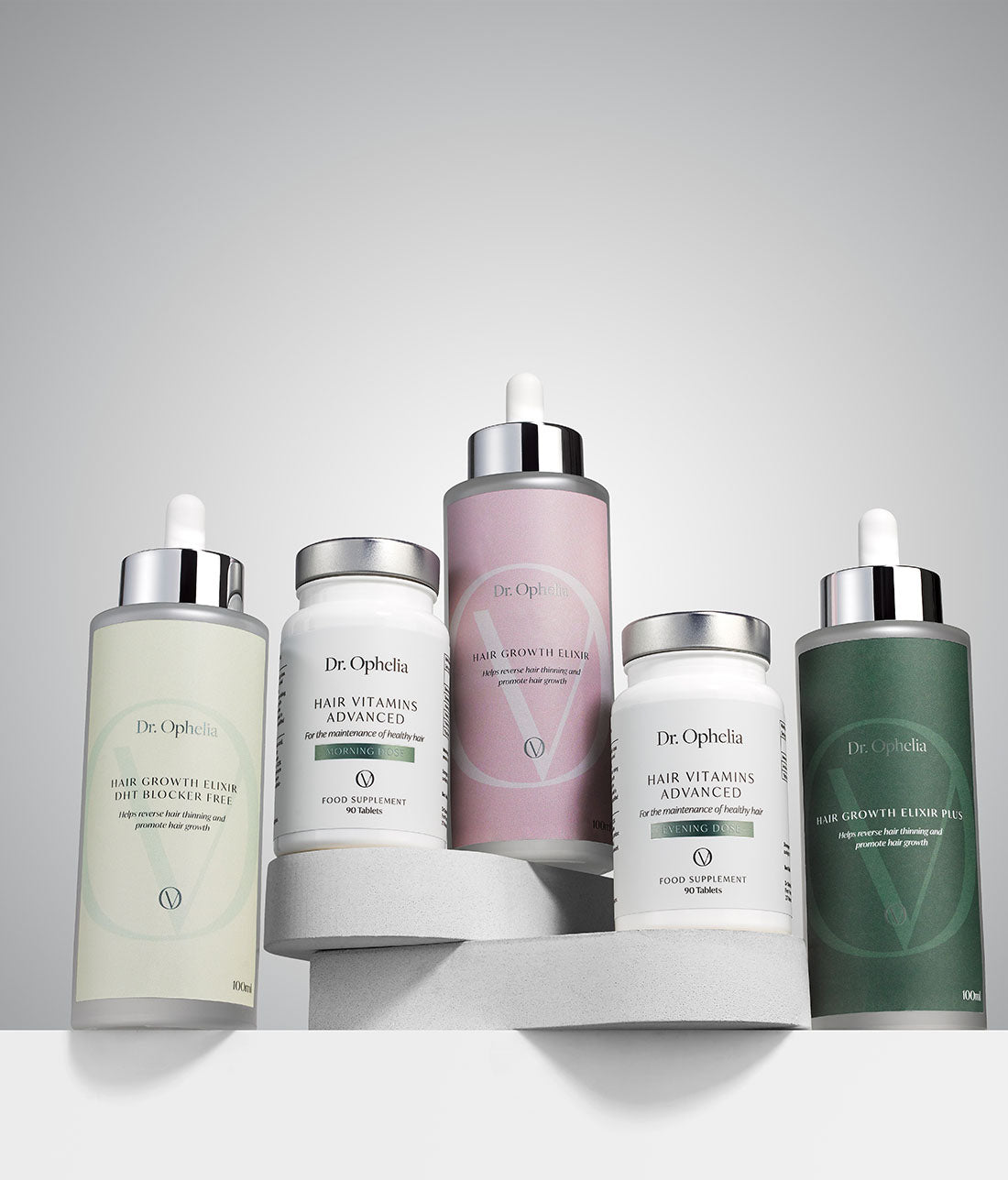
Alongside her clinical work, Dr. Ophelia has developed her namesake line of prescription-strength skin and hair products, bringing her world-class knowledge and experience directly into patients’ hands, to continue treating their skin at home.
