
Urticaria
BOOK A CONSULTATIONWhat Is Urticaria and What Causes It?
- Hives and chronic spontaneous urticaria
- Mast cell and histamine driven
- Acute and chronic forms
- Accurate diagnosis essential
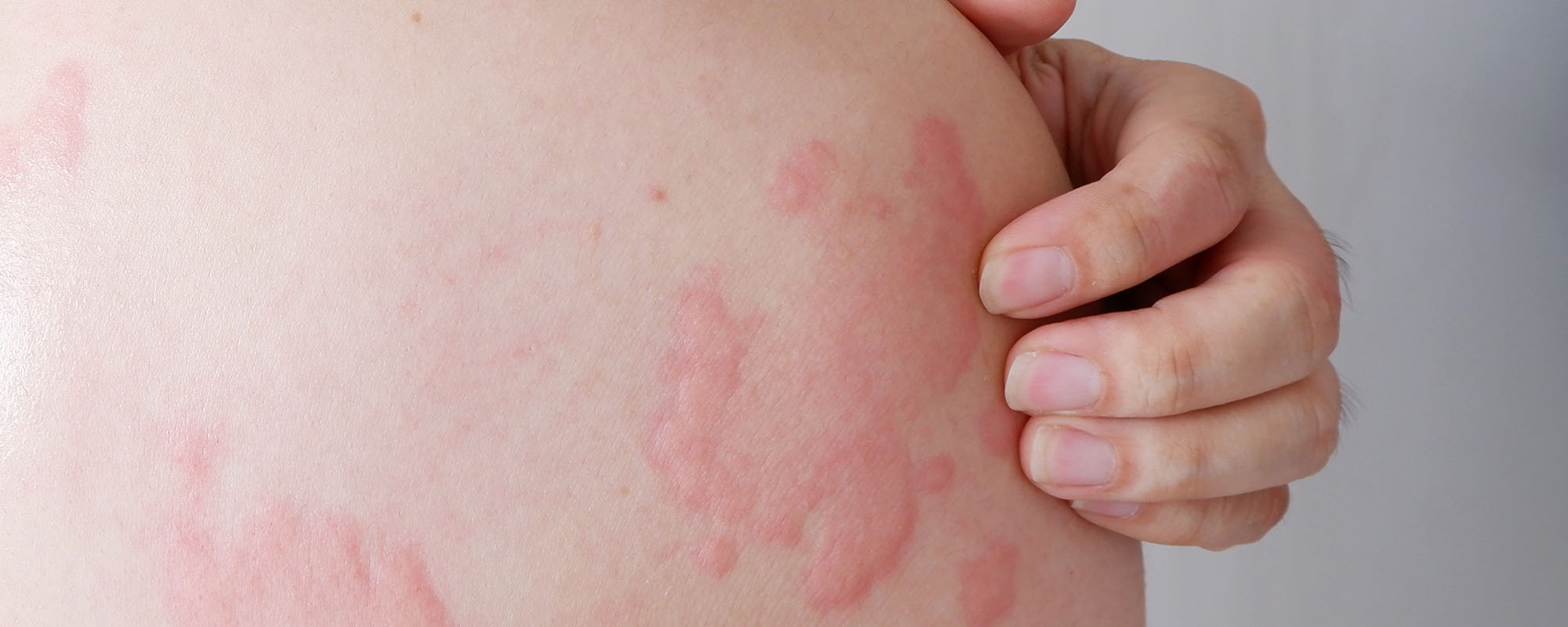
Urticaria, commonly known as hives, is characterised by the sudden appearance of raised, red or skin-coloured itchy wheals, often with surrounding redness and a burning or stinging sensation. Individual wheals vary from a few millimetres to several centimetres and typically resolve within 24 hours, though new lesions may keep appearing in a shifting, migratory pattern. In some patients, deeper swelling of the skin and subcutaneous tissues occurs at the same time - angioedema - most commonly affecting the lips, eyelids, tongue, throat, and hands. When angioedema involves the throat or airway, it requires urgent medical attention.

Urticaria is classified by duration and trigger pattern. Acute urticaria lasts less than six weeks and is often triggered by an identifiable cause such as an infection, medication, food, or insect bite. Chronic urticaria persists beyond six weeks and divides into chronic spontaneous urticaria (CSU), in which wheals occur without a consistently identifiable trigger, and chronic inducible urticaria, in which symptoms are reliably provoked by a physical stimulus such as cold, pressure, heat, vibration, or sunlight. CSU is the most complex and disruptive form; it often has no obvious cause and can persist for months or years, with a significant impact on quality of life, sleep, and daily functioning.
The underlying mechanism involves activation of mast cells within the dermis, releasing histamine and other inflammatory mediators that cause vasodilation, increased vascular permeability, and the characteristic wheal-and-flare response. In CSU this activation is often autoimmune, driven by autoantibodies directed against IgE or the high-affinity IgE receptor on mast cells, which explains why it can persist without an external trigger. Associations with thyroid autoimmunity and other autoimmune conditions are recognised and should be investigated.
Urticaria is also frequently misdiagnosed or inadequately investigated. Conditions that can resemble it include urticarial vasculitis (lesions persisting beyond 24 hours and leaving bruising), early urticarial-phase bullous pemphigoid, systemic mastocytosis, and autoinflammatory conditions such as Schnitzler syndrome - all with very different causes and management. Distinguishing them requires careful clinical assessment, blood tests, and sometimes skin biopsy, so seeing a Consultant Dermatologist rather than managing the condition empirically ensures these important diagnoses are not missed.
What Are My Treatment Options for Urticaria?
- Second-generation antihistamines
- Omalizumab biologic therapy
- Immunosuppressants for refractory disease
- Trigger identification and investigation
Effective treatment begins with accurate diagnosis and a thorough assessment to identify the type and, where possible, the underlying cause or trigger. For acute urticaria, identifying and removing the precipitating cause - a food, medication, infection, or contact trigger - is often the most important step. For chronic urticaria, assessment involves a structured history, targeted blood tests (full blood count, thyroid function, inflammatory markers, and autoimmune screening), and occasionally skin biopsy where urticarial vasculitis or another diagnosis must be excluded.
Second-generation non-sedating antihistamines are the first-line treatment. Unlike first-generation antihistamines, they have a more favourable side-effect profile and can be used at standard or up-dosed regimens. Current international guidelines support licensed antihistamines at up to four times the standard dose in patients with inadequate control - a strategy that significantly increases the proportion achieving good control without escalating to more complex treatments. The right antihistamine, dose, and duration requires clinical judgement, as it varies between patients and urticaria subtypes.
For moderate to severe CSU that does not respond to optimised antihistamines, omalizumab is the recommended second-line therapy. A biologic given by subcutaneous injection every four weeks, it targets IgE and reduces mast cell reactivity, with clinical trials demonstrating rapid, significant reductions in urticaria activity, itch severity, and quality of life impairment, and an excellent long-term safety profile. As a Consultant Dermatologist, Dr Ophelia has the prescribing authority and expertise to initiate and manage omalizumab for CSU, giving patients access without the delays that can affect NHS pathways.
For those who do not respond adequately to omalizumab, or where alternative immunomodulatory approaches are needed, oral immunosuppressants including ciclosporin and, in selected cases, other systemic agents may be considered under careful monitoring within a structured, supervised plan. In inducible urticaria, treatment is tailored to the specific physical trigger, with avoidance strategies discussed alongside medication. Throughout, the psychological burden of chronic urticaria - which can be substantial - is addressed directly, with appropriate support or referral where quality of life is significantly affected.

Why See Dr Ophelia Veraitch for Urticaria Treatment in London?
- Award-winning Consultant Dermatologist - accurate diagnosis and the full treatment spectrum
- Thorough investigation - excluding urticarial vasculitis and other important diagnoses
- Omalizumab prescribing expertise - biologic therapy for chronic spontaneous urticaria
- Patient-centred care - quality of life and psychological impact addressed
Chronic urticaria, in particular, is frequently undermanaged. Many patients spend months or years cycling through standard antihistamines without being offered the up-dosed regimens recommended in current guidelines, let alone the biologic therapies that have transformed outcomes for CSU. Others have never had adequate investigation to confirm the diagnosis or identify contributing autoimmune or systemic factors. Dr Ophelia Veraitch offers both the diagnostic rigour and the full therapeutic range to manage urticaria comprehensively, from initial assessment to advanced biologic therapy.
Accurate diagnosis is the essential starting point. Urticarial vasculitis, early bullous pemphigoid, and systemic mastocytosis can present with features clinically indistinguishable from conventional hives without investigation, and urticarial vasculitis in particular is frequently missed despite its systemic implications. Dr Ophelia's assessment is systematic and thorough, ensuring these diagnoses are identified or excluded before a management plan is created.
For patients needing escalation beyond antihistamines, she has the prescribing expertise and experience to initiate and manage omalizumab in a private specialist setting, without the waiting times that can affect NHS pathways, and to monitor and adjust treatment over time. For the minority who require immunosuppressive therapy, she provides the same structured, specialist-supervised approach that complex chronic urticaria demands.
She also understands that living with poorly controlled chronic urticaria can be exhausting, anxiety-provoking, and profoundly disruptive. Her goal is to give each patient a clear diagnostic framework, an evidence-based, appropriately escalated treatment plan, and confidence that their condition is being managed by a specialist who takes it as seriously as they do.
HELP
Frequently Asked Questions - Urticaria
Acute urticaria lasts less than six weeks and is often triggered by an infection, a new medication, a food, or an insect bite, frequently resolving once the trigger is removed. Chronic urticaria lasts more than six weeks and divides into chronic spontaneous urticaria (no consistently identifiable trigger) and chronic inducible urticaria (provoked by a physical stimulus such as cold, pressure, heat, or sunlight). CSU is the most complex form and the most likely to require specialist management.
Urticaria produces raised, itchy wheals on the skin surface that resolve within 24 hours and shift location. Angioedema involves deeper swelling of the skin and subcutaneous tissues - most commonly the lips, eyelids, tongue, throat, and hands - and can occur alongside urticaria or independently. When it involves the throat or tongue it can compromise the airway and requires urgent attention. Its distinct histaminergic and bradykinin-mediated subtypes respond to different treatments, so distinguishing them is an important part of specialist assessment.
Food allergy is a recognised trigger for acute urticaria, most commonly nuts, shellfish, fish, milk, and eggs. In CSU, however, it is a far less frequent factor than patients assume; most have no clinically significant food allergy, and elimination diets without specialist assessment are unproductive and carry nutritional risk.
Standard tests include a full blood count, inflammatory markers (CRP and ESR), thyroid function and thyroid autoantibodies, and in selected cases further autoimmune screening. Where urticarial vasculitis is suspected, complement levels, urinalysis, and skin biopsy may be needed, and possible inducible urticaria can be confirmed with physical provocation testing. The extent of investigation is guided by each patient's clinical picture.
It is a distinct condition in which individual wheels last longer than 24 hours, often leaving residual bruising or discoloration, and may burn rather than purely itch. It involves inflammation of the small blood vessels and can have systemic associations including joint pain, kidney involvement, and links with autoimmune conditions such as lupus. It requires skin biopsy for definitive diagnosis and has different treatment implications - one of the important diagnoses missed when urticaria is managed empirically.
Yes. Second-generation antihistamines - including cetirizine, loratadine, and fexofenadine - are the recommended treatment and are preferable to first-generation options such as chlorphenamine: longer-acting, less sedating, and with a better side-effect profile. Guidelines support using them at up to four times the licensed dose where control is inadequate, before escalating to biologic therapy.
Omalizumab is a biologic given by subcutaneous injection every four weeks that targets IgE, reducing mast cell sensitivity and reactivity. In CSU that has not responded to antihistamines, it is the recommended second-line treatment, with trials showing rapid, significant reductions in urticaria activity, itch severity, and quality of life impairment, and an excellent long-term safety profile. It requires specialist prescribing and monitoring and is available at Dr Ophelia's clinic without the NHS waiting times.
Yes. Psychological stress is a well-recognised trigger and aggravating factor: it can activate mast cells and lower the threshold for histamine release, and the relationship can become cyclical as the distress of poor control generates further stress. Dr Ophelia addresses this dimension as part of management and can facilitate support or referral where it is a significant contributor.
A form of chronic urticaria in which wheals are consistently triggered by a specific physical stimulus rather than occurring spontaneously. Subtypes include cold urticaria; symptomatic dermographism (wheals from firm stroking of the skin); delayed pressure urticaria; solar urticaria; heat urticaria; and cholinergic urticaria (rises in body temperature from exercise, hot baths, or emotion). Identifying the specific trigger guides both treatment and avoidance advice.
Natural history is variable. About half of patients remit within a year of onset, and most eventually achieve spontaneous remission over years, though a significant minority have a protracted course of five years or more. Activity tends to wax and wane, and treatment can often be tapered and discontinued as disease activity reduces.
A GP can prescribe standard antihistamines and manage straightforward acute urticaria. For chronic urticaria not responding to standard treatment, a Consultant Dermatologist offers key advantages: investigating and excluding alternatives such as urticarial vasculitis; expertise in up-dosed antihistamine regimens; access to omalizumab and other advanced therapies for refractory disease; and the clinical judgement to manage complex or treatment-resistant cases. Patients living with poorly controlled urticaria for months or years without adequate assessment consistently benefit from specialist input.