
Scalp Psoriasis
BOOK A CONSULTATIONWhat is scalp psoriasis and how does it differ from other scalp conditions?
- Affects up to 80% of psoriasis patients
- Thick scale on a red, inflamed scalp
- Can extend beyond the hairline
- Accurate diagnosis essential
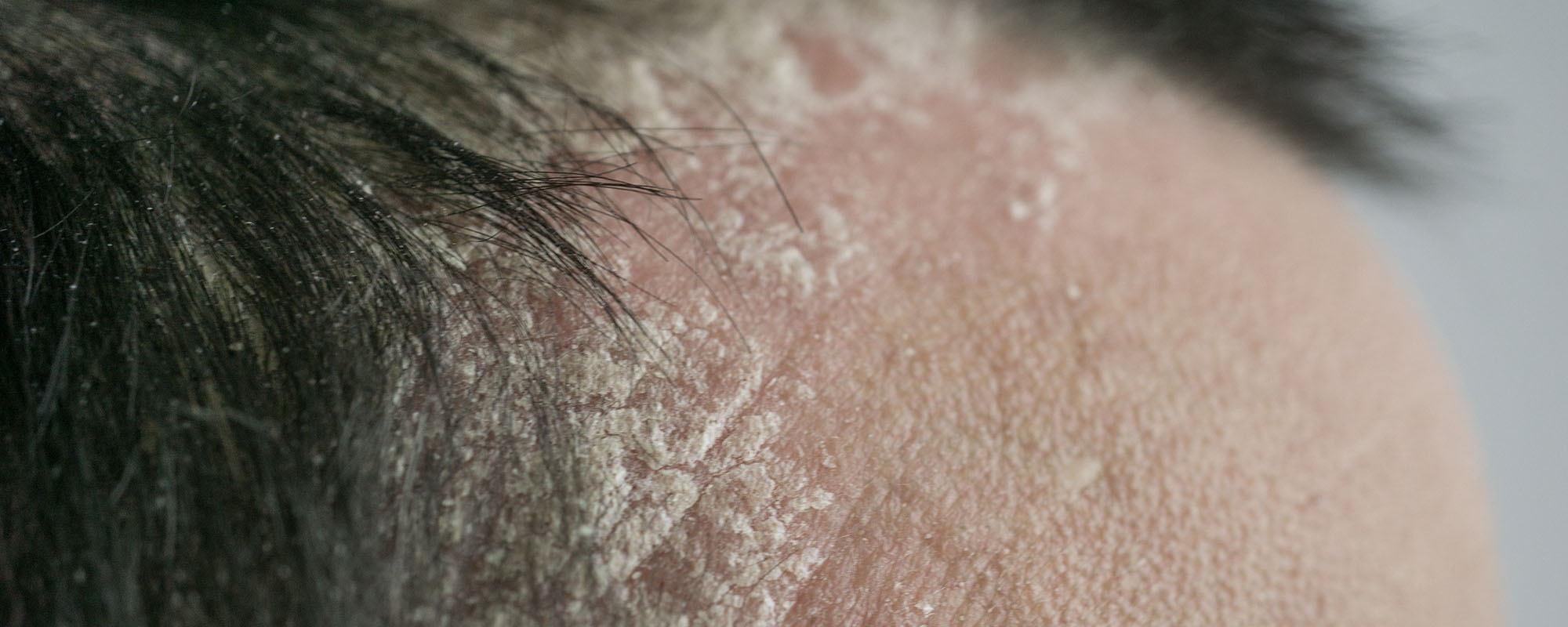
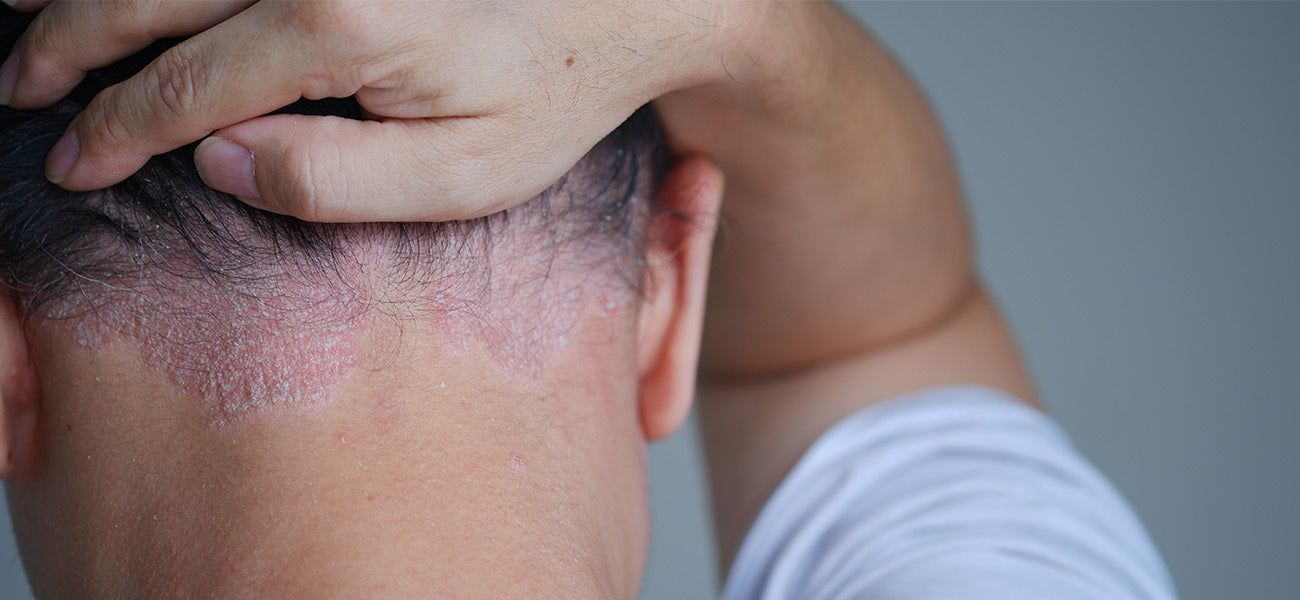
Scalp psoriasis is one of the most common and most undertreated manifestations of psoriasis, affecting up to eighty percent of patients at some point. It presents as well-defined, thickened plaques of inflamed skin covered by dense, silvery-white scale, ranging from one or two patches to the entire scalp, and often extends beyond the margin onto the forehead, temples and behind the ears. Symptoms range from minimal to intensely itchy, and constant flaking affects daily life and can meaningfully impact confidence.

Accurate diagnosis is essential and more nuanced than it may appear. Scalp psoriasis shares features with seborrhoeic dermatitis, another common scalp condition, and the two can coexist. Seborrhoeic dermatitis tends to produce finer, greasier scale with less distinct margins, while psoriasis produces thicker, more adherent, silvery scale on clearly demarcated, elevated plaques. Distinguishing them matters because treatment differs, and a patient treated for seborrhoeic dermatitis without adequate response may in fact have scalp psoriasis, or both. Contact dermatitis, tinea capitis (scalp ringworm) and lichen planopilaris can also produce scalp scaling and inflammation and should be excluded where relevant, particularly if standard treatments are not working.
In most patients scalp psoriasis does not cause permanent hair loss, but it can cause temporary shedding during active, severe flares, driven by inflammation and disruption to the hair follicle cycle; prolonged inflammation or vigorous scratching can affect density more. Once the psoriasis is controlled, hair typically recovers. Where a condition such as female pattern hair loss coexists, advanced scalp imaging with HairMetrix and the Global Hair Device allows objective measurement of hair density and follicle calibre, guiding both psoriasis and hair loss treatment.
What are my treatment options for scalp psoriasis?
- Medicated shampoos and scalp preparations
- Topical corticosteroids, calcineurin inhibitors, and scalp psoriasis formulations (coal tar, coconut oil, vitamin D, salicylic acid)
- Oral systemic treatments
- Biologic therapies
- Hair density monitoring with HairMetrix
After accurate diagnosis and assessment of the scalp involvement, any psoriasis elsewhere and any associated hair loss, Dr Ophelia develops a personalised plan combining scalp-specific preparations with systemic treatment where warranted, and monitors response objectively at every visit.
Scalp-specific topical treatments are the first line for most patients. Medicated shampoos containing coal tar, salicylic acid or ketoconazole reduce scale, lift adherent plaques and make the surface more receptive to active treatments. Potent scalp-formulated topical corticosteroids (solutions, foams, gels and shampoos) are the most effective agents for reducing inflammation and clearing plaques, and vitamin D analogues are used alone or in fixed-dose combination with a corticosteroid to reduce keratinocyte proliferation and scaling. Dr Ophelia provides guidance on correct application, a structured reducing regimen and maintenance treatment; technique, timing and sequencing make a significant difference to effectiveness.
Where scalp psoriasis is not adequately controlled with topical preparations, or is part of extensive body involvement, systemic treatment is needed. Oral therapies including methotrexate, ciclosporin and acitretin are used according to disease severity, previous response and individual health factors where topical treatment alone has failed, and require careful monitoring and prescribing by an experienced Consultant Dermatologist.
Biologic therapies have transformed outcomes for moderate to severe psoriasis, including scalp involvement. Agents targeting TNF-alpha, IL-17, IL-12/23 and IL-23 pathways have all demonstrated efficacy, with the IL-17 and IL-23 inhibitors in particular showing high rates of scalp clearance. Where scalp psoriasis is severe, resistant, or accompanied by significant body involvement, psoriatic arthritis or a meaningful quality-of-life impact, it can produce clearance that topical and conventional systemic treatments cannot. In a private specialist setting, access is not subject to the eligibility thresholds that apply on the NHS.
Where scalp psoriasis has caused hair thinning or shedding, or coexisting hair loss is present, Dr Ophelia incorporates hair restoration treatments once the inflammation is controlled. These may include regenerative in-clinic treatments such as platelet-rich fibrin (PRF) therapy, dutasteride mesotherapy and polynucleotides, alongside topical and oral hair growth therapies.
Why should I see Dr Ophelia Veraitch for scalp psoriasis treatment in London?
- Consultant dermatologist with inflammatory skin and hair expertise. Uniquely placed to manage scalp psoriasis and its hair consequences
- Full prescribing range. Topicals, systemics and biologics for psoriasis
- HairMetrix and Global Hair Device. Objective scalp and hair monitoring at every visit
- Hair restoration treatments. PRF, dutasteride mesotherapy and polynucleotides where needed
Scalp psoriasis sits at an intersection few clinicians manage comprehensively: it is at once an inflammatory skin condition requiring dermatological expertise and a scalp condition with direct consequences for hair density and follicle health.
Dr Ophelia Veraitch is one of the few Consultant Dermatologists in the UK bringing deep expertise in both inflammatory skin disease and hair and scalp disorders to the same consultation.
Her approach begins with accurate diagnosis, as many patients with a scaly, inflamed scalp have been treated empirically for seborrhoeic dermatitis or dandruff without proper assessment. She takes a thorough history, examines the scalp with dermoscopy where relevant, and considers the full differential before prescribing the full range of options, without the formulary restrictions that limit NHS treatment. Objective monitoring with HairMetrix and the Global Hair Device shows how the scalp and hair are responding, and every patient leaves with a clear plan and realistic expectations.
HELP
Frequently Asked Questions — Scalp Psoriasis
A chronic inflammatory skin condition affecting up to 80% of people with psoriasis, causing thickened plaques covered by dense, silvery-white scales that often extend beyond the hairline onto the forehead and behind the ears.
Scalp psoriasis produces thick, adherent, silvery scale on clearly raised plaques, whereas seborrhoeic dermatitis (the usual cause of dandruff) produces finer, greasier scale with less distinct margins; the two can coexist, so diagnosis matters.
It rarely causes permanent hair loss but can cause temporary shedding during severe flares or from vigorous scratching; hair typically recovers once the psoriasis is controlled, and any coexisting female pattern hair loss is managed alongside it.
Medicated shampoos (coal tar, salicylic acid, ketoconazole), potent scalp-formulated corticosteroids and vitamin D analogues, escalating to oral methotrexate, ciclosporin or acitretin, and biologics (especially IL-17 and IL-23 inhibitors) in moderate to severe disease.
Advanced injectable treatments targeting the TNF-alpha, IL-17, IL-12/23 and IL-23 pathways, with IL-17 and IL-23 inhibitors giving especially high scalp clearance; they are available privately on clinical grounds without NHS eligibility thresholds.
Yes; it can be mimicked by seborrhoeic dermatitis, contact dermatitis, tinea capitis (scalp ringworm) and lichen planopilaris, and dermoscopy helps distinguish them when treatments are not working.
Use medicated shampoos first to lift scale, apply corticosteroid preparations directly to the scalp skin rather than the hair shaft, and follow a structured reducing regimen with maintenance to prevent relapse.
Most are well tolerated, and controlling the inflammation usually allows any treatment-related shedding to resolve; thinning can be monitored objectively and addressed with hair restoration treatments.
An advanced scalp imaging system that objectively measures hair density and follicle calibre and, with the Global Hair Device, tracks response and detects any deterioration early, especially where hair loss coexists.
Once inflammation is controlled, options include platelet-rich fibrin (PRF) therapy, dutasteride mesotherapy and polynucleotide treatments, plus topical and oral hair growth therapies, according to the hair loss and any coexisting female pattern hair loss.
Potent topicals and, where needed, systemic or biologic therapies are not available over the counter, and a Consultant Dermatologist with expertise in both inflammatory skin disease and scalp and hair disorders is uniquely placed to manage the psoriasis and its consequences for hair health.
Plaques often extend beyond the hairline onto the forehead, temples and behind the ears, and scalp psoriasis frequently coexists with psoriasis elsewhere; psoriatic arthritis occurs in some patients and should be assessed.
Potent topical corticosteroids can reduce inflammation and scaling within one to two weeks; systemic or biologic treatment may take longer, though biologics can clear significantly within weeks, with structured maintenance afterwards to prevent relapse.
Psoriasis is chronic with no cure but can be effectively controlled, with many patients achieving prolonged clearance; the goal is the best possible control sustained with maintenance, and with today's treatments the outlook has improved significantly.